SMARTGRANDADS OPINION: BYD BLADE 2 & FLASH CHARGING: EV Charging Catches Up To ICE Refueling
The 9-Minute Revolution:
Why the BYD Blade 2 Changes Everything for EV Owners
Now as Smartgrandad, I’ve been driving for 55+ years and have seen many big changes in the car industry, the including the dis-appearance of the British car industry, Japan’s rise due to the quality of their products, the introduction of hatchbacks, SUVs, and the move to diesel cars during the 1990s.
EV Revolution in the Car Industry
Now, electric powered vehicles are making the biggest change in a century. Led by the US (Tesla), Korean (Kia & Hyundai) and Chinese (BYD, etc. EV manufacturers are slowly but sure taking over the market from petrol & diesel ICE vehicles. Over the last 7 years, I have personally owned Kia eNiro, Kia EV 6 and Xpeng G9P), and used numerous others (Tesla Model 3 & Model Y, Polestar 2, Mercedes EQB, Vauxhall Corsa, Fiat 500, etc.) from Hire companies.
Range Anxiety Limits Mass EV Adoption
Initially, when going on longer trips, charging “On the Go” needed to be planned carefully as “Range Anxiety” was real as Chargers were few and far between. Plus, once you found a charger, usually 50kw, a 45-60 minute stop was required to get a full battery or in the worst case only net you 60 more miles. My Kia e-Niro, took about 44 minutes on a good day to reach 80% at a 50kw charger. Luckily, those of us with driveways could install Home chargers and even though charging at 11kw, overnight charging always resulted in leaving home with a full battery.
More Charging Infrastructure – Less Journey Planning
Today, in 2026, there are many 800v vehicles that can charge very quickly (e.g. BMW, Mercedes, Audi, Cadillac, Chevy, Hyundai, Kia, BYD, Xpeng and other Chinese brands) and a many more chargers that support 350-400 Kw charging, With the right EV and the right chargers motorway charging stops are now between 25-30 mins long. Still longer than petrol / diesel, but not much longer than it takes to visit the rest room and have a coffee break.
Changing the Game – BYD’s new Flash Charging technology and its second-generation Blade 2 battery
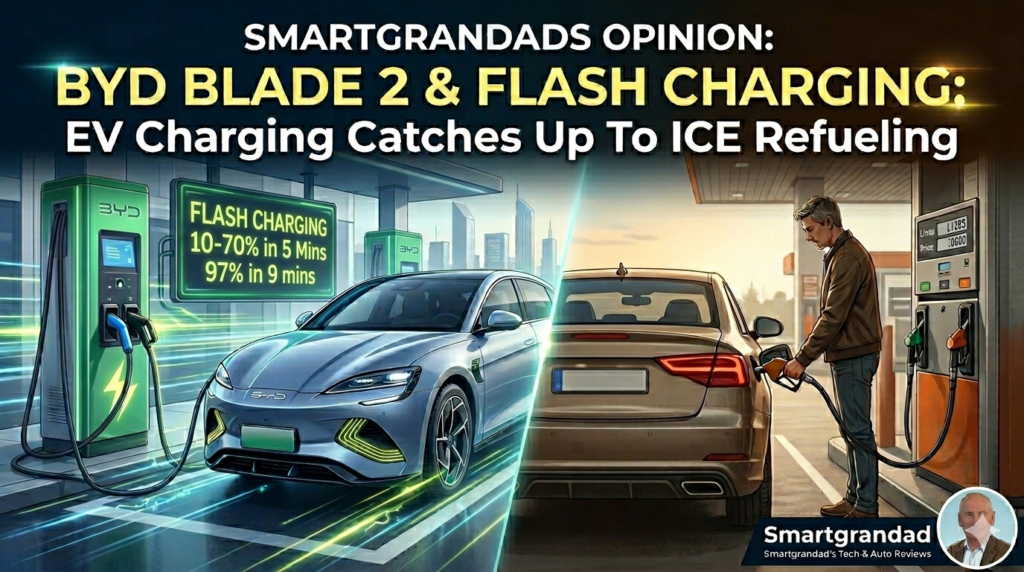
The most common criticism of EVs is that they simply don’t charge fast enough for people on the move. BYD has answered this with a staggering promise: a 10% to 70% charge in just five minutes. If you want what they call a “full charge”—which they’ve capped at 97% to leave room for regenerative braking—it takes only nine minutes.
To put that in perspective, that is roughly the same amount of time it takes to fill a traditional petrol or diesel car. This brings a “petrol station vibe” to the EV world, removing the hybrid compromise that has historically held back mass EV adoption. We are moving away from having to plan our lives around the car’s charging schedule and toward a world where the car fits into ours.
Improving Safety – BYD Blade 2 Battery is a Safety Fortress
Safety is always a top priority for any driver. One of the reasons I trust BYD’s approach is their commitment to LFP (Lithium Iron Phosphate) chemistry. Unlike older batteries, these are cheaper, don’t contain ethically “dodgy” nickel or cobalt, and are much less likely to explode.
The second-generation Blade battery is a marvel of engineering. It is packaged with superior airflow to keep it in a “Goldilocks zone”—warm enough to charge quickly but cool enough to prevent premature degradation. But the real kicker is the safety testing. BYD famously performs a nail penetration test where they pierce the battery while it’s charging; even under that extreme stress, there is no explosion or fire. They even drop their battery packs from heights ten times higher than regulations require, and the packs remain perfectly safe. This level of vertical integration—where BYD makes the batteries, the cars, and the chargers—is what makes this technology so seamless and trustworthy, a model used by Apple.
Solving the Winter Charging Woes
In freezing climate, normal batteries experience “cold-gating“. Without preconditioning, warming the battery, a charge that usually takes 44 minutes can easily stretch to an hour and a half. BYD has solved this by ensuring the Blade 2 battery is effectively always preconditioned.
In their testing, even in brutal -30°C temperatures, the battery can still pull a 20% to 97% charge in just 12 minutes. There’s no need to manually press a button or navigate to a charger to warm up the battery; it’s ready the moment you plug in. For drivers in chilly climates, this is a transformative development that makes EVs viable year-round without the massive time penalty.
Thinking Beyond the Car: The Grid and Accessibility
One might worry that charging at 1,500 kW—which is significantly higher than the current 350 kW “high power” chargers—would blow the local power grid. This is where BYD’s “magic” comes in. The charging stations include power cabinets equipped with the same Blade batteries found in the cars.
These cabinets act as a buffer, storing energy from the grid when rates are low and demand is quiet, then “funneling” that power into the car during a flash charge. This means no massive grid upgrades are required; a station can replace a medium-power charger with a flash charger using the existing connection.
Furthermore, BYD has clearly thought about accessibility. High-power cables are notoriously heavy, but BYD’s flash charging stations use a distinctive T-shape design that suspends the cable, making it “weirdly light” and easy to slide into the port. The payment interface is also set lower down, making it easier for everyone to use.
A Glimpse into the Future
While this technology is currently debuting in high-end models like the Denza Z9 GT—a powerhouse that can “crab walk” and hit 62 mph in 2.7 seconds—it won’t stay exclusive for long. BYD plans to roll this technology out starting now with the BYD Seal and then across their entire range.
By the end of next year, the plan is to have 3,000 of these stations across Europe, with 300 aimed for the UK by 2027. But what excites me most isn’t just the cars; it’s the potential for vans and trucks, which we are already seeing more and more of in our cities and on the motorways. When a delivery driver or a long-haul trucker can top up their vehicle in the time it takes to have a lunch break, the final barriers to a fully electric transport network will crumble.
Smartgrandad’s Final Thoughts
We often hear the term “game changer” in the tech world, but usually, it’s just a lab demo. This isn’t vaporware; it’s already established in China with thousands of chargers already installed.
The BYD Blade 2 battery and Flash Charging system represent the most significant leap forward I’ve seen in years. It addresses speed, safety, winter performance, and grid stability in one fell swoop. For those of us who have been waiting for the “petrol station experience” in an electric package, the wait is finally over.
It’s an exciting time to be an EV owner, and I can’t wait to see these T-shaped chargers popping up at our motorway services very soon. Not wanting to fall behind, I am sure that it won’t be long before the competitors will start evolving to other Flash Charging solution like solid state.