OPINION:
UK EV TAX: A Minor “BLIP”
Written by SmartGrandad – BEV enthusiast and BEV owner for over 7 years.
The UK’s transition to Battery Electric Vehicles (BEVs) has been rapid, but with this shift comes a significant challenge for the Treasury: replacing the multi-billion-pound revenue lost from declining fuel duty receipts.
The government has confirmed a major change to motoring tax, introducing a mileage-based charge for electric and plug-in hybrid vehicles.
Here is a breakdown of what the new tax entails, how it will affect EV owners, and the projected impact on UK EV sales.
What is the UK’s New EV Tax?
The new tax, often referred to as Electric Vehicle Excise Duty (eVED), is a per-mile charge for drivers of zero and low-emission vehicles, set to be implemented from April 2028.
It is designed to ensure that all drivers contribute to the upkeep of the road network, regardless of their fuel source.
Key Details of the eVED:
Vehicle Type | Rate (from April 2028) | Rationale |
Battery Electric Vehicles (BEVs) | 3 pence per mile | Designed to be approximately half the per-mile equivalent of fuel duty paid by petrol/diesel drivers. |
Plug-in Hybrid Electric Vehicles (PHEVs) | 1.5 pence per mile | A lower rate, acknowledging that PHEV drivers still pay fuel duty when running on their petrol engine. |
Note: These rates will increase annually in line with the Consumer Price Index
How Will it Be Paid?
The government is currently consulting on the exact mechanism, but the plan is to integrate it with the existing Vehicle Excise Duty (VED) system, administered by the DVLA.
- Payment Method: Drivers will be required to estimate their annual mileage when renewing their VED and pay the charge upfront (or spread the cost).
- Reconciliation: The vehicle’s actual mileage will be recorded at the annual MOT test. If a driver has exceeded their estimated mileage, they will pay the difference; if they have driven less, they will receive a refund.
- No Tracking: Crucially, the government has confirmed it will not be using tracking devices or “black boxes” to monitor driver location, stating the system will rely on odometer readings.
How Will the eVED Affect EV Owners?
While the new tax will undoubtedly increase the running costs for EV owners, experts suggest that for the average driver, an EV will still remain substantially cheaper to run than an equivalent petrol or diesel car.
Increased Annual Running Costs
An average UK EV driver, travelling 8,500 miles per year, can expect an additional annual cost of approximately £255 (8,500 miles x £0.03). This is on top of the standard annual VED of £195 that EVs are already being transitioned onto from April 2025.
High-Mileage Drivers Will Pay More
The impact will be most significant for high-mileage drivers, such as company car drivers or those who travel long distances regularly. While this group will still save money compared to an equivalent petrol vehicle, the proportional increase in their annual tax bill will be higher. For example, a driver covering 15,000 miles per year will pay around £450 in eVED.
Mitigation from Other Incentives
To offset the impact, the government has announced some counterbalancing measures:
- Expensive Car Supplement (ECS) Threshold Raised: The threshold for the ‘Luxury Car Tax’ surcharge for EVs will be raised from £40,000 to £50,000 from April 2026. This will exempt many popular, higher-spec EVs from an extra £425 annual charge.
- Electric Car Grant Extension: The Electric Car Grant scheme, which provides discounts on eligible new EVs, has received an additional £1.3 billion in funding, extending its life until 2029-30.
The Impact on UK EV Sales
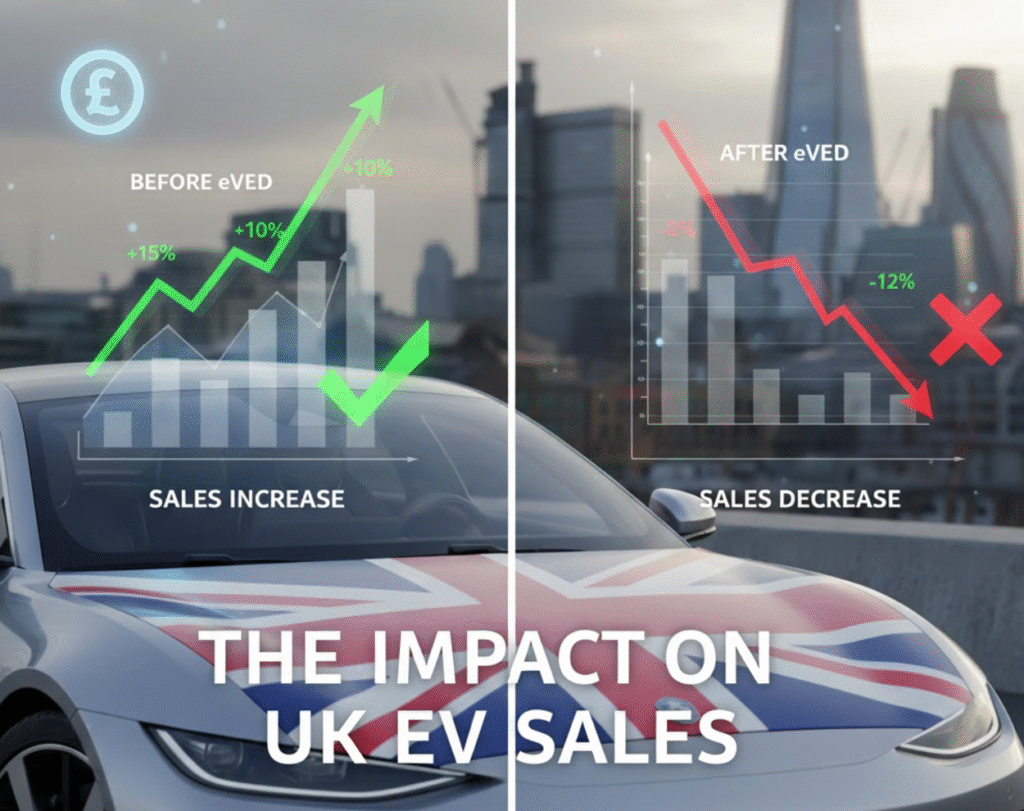
The introduction of the eVED presents a complex picture for the future of the UK’s EV market, balancing the need for government revenue against the acceleration of the net-zero transition.
The Headwind: A Potential Slowdown
The Office for Budget Responsibility (OBR) itself forecasts that the new mileage-based charge could lead to a net reduction in EV sales.14 The analysis suggests that the increased running costs will put off some potential buyers, slowing the pace of adoption. Industry bodies have also warned that the tax risks sending a “confusing message” to motorists about the government’s commitment to the electric transition.
The Tailwind: EV’s Remain the Cheaper Option
Despite the tax, the core economic advantages of EVs largely remain:
Lower Cost per Mile:
Even with the 3p/mile tax, the cost per mile of an EV (primarily charging cost plus tax) remains significantly lower than a petrol or diesel car due to the high cost of fuel duty.
Long-Term Strategy:
The government’s decision to maintain and increase grants, while raising the luxury tax threshold, signals a clear long-term strategy to support the transition. The tax is an evolution of a motoring tax system, shifting from taxing fuel to taxing road usage.
A MINOR “BLIP” ON THE EV ROAD
To most EV drivers, it is not surprising that such a tax would have to come into being at some point as the significant loss of Petrol/ Deisel fuel tax revenue needed to be balanced out.
In essence, while the tax is a minor hurdle that makes EVs slightly more expensive to run than before, it does not eliminate the overall cost advantage of electric motoring.
Its main impact may be on the momentum of the market, which is why the accompanying incentives are crucial to keep sales on track towards the 2030 ban on new fossil fuel car sales.

NEW: #4 SG EXPLAINS XPENG APP REMOTE CLIMATE CONTROLS
#3 SG SG EXPLAINS XPENG APP – NAVIGATION
Want SMARTGRANDAD to explain something on EVs, just send the suggestion in the Feedback section below.
If you want SMARTGRANDAD to write an EV related article, just send the suggestion in the Feedback section below.