OPINION:
EV Ownership in 2026 & Why the Headlines Get It Wrong!
Written by SmartGrandad – BEV enthusiast and BEV owner for over 7 years.
SmartGrandads Opinion
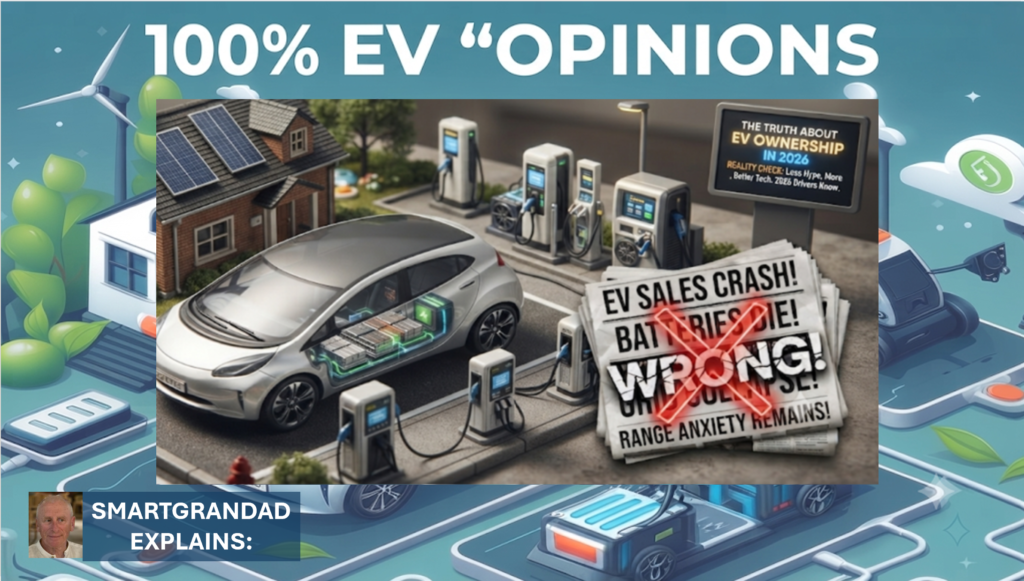
If you’ve been reading the mainstream news lately, you might think the Electric Vehicle (EV) revolution is stalling. Between the doom-and-gloom headlines about “fading interest” and the frankly tiresome, clickbait pieces on battery fires, it’s easy for a would-be buyer to feel a bit hesitant.
But look, I’ve been living the EV life for years now. I’ve clocked the miles, I’ve navigated the charging stops, and I’ve dealt with the naysayers at the dinner table. And I’m here to tell you that what you read online and in the morning papers is often a long way from the reality of owning and driving an electric car in 2026.
Let’s cut through the noise. The media loves a “crisis” because it sells papers. I prefer the truth because it makes for a better drive.
The "Demand" Myth
We keep hearing that EV demand is “falling.” Honestly? It’s a laughable take. The market isn’t collapsing; it’s simply maturing.
We’ve moved past the “early adopter” phase—where everyone wanted the newest, shiny tech gadget on wheels—and into a phase where everyday drivers, like you and me, are looking for reliability and value. Global sales are continuing to climb, hitting record numbers in 2026.
While the growth percentage might not be the wild, unsustainable “frenzied” numbers we saw post-pandemic, the transition to electric isn’t just happening—it’s accelerating. Don’t mistake a maturing market for a failing one.
The Cost Perspective: It’s Not Just the Sticker Price
The most common objection I still hear is, “But EVs are too expensive!”
It’s true that the initial purchase price can look higher than an internal combustion engine (ICE) vehicle on the showroom floor. However, looking only at the sticker price is like judging a book by its cover.
When you factor in the Total Cost of Ownership, the story changes completely. As an EV owner, you stop paying for those endless oil changes, timing belts, and the soul-crushing cost of complex exhaust repairs.
My own experience—and the data—shows that EVs have significantly fewer moving parts to break. Add in the massive savings from charging at home (often a fraction of the cost of petrol) and you’ll find that, over a few years, an EV is, more often than not, the more economical choice.
Safety: A Necessary Conversation
We need to talk about the “battery fire” narrative. It is the favorite hobbyhorse of the fear-mongers.
Let’s look at the actual statistics, shall we? An electric vehicle is statistically much less likely, some say up to 60 times less likey, to catch fire than a petrol or diesel car. Modern EVs are engineered with sophisticated thermal management systems and are built to be incredibly robust.
When you consider the thousands of internal combustion engines that catch fire every year due to fuel leaks or engine failure, the media’s obsession with EV fires feels—at best—disproportionate and—at worst—deliberately misleading.
Battery technology improvements are coming thick and fast with BYDs Blade 2 and Solid State reducing the fire risks even further.
The Bottom Line On EV Sales
The reality of driving electric in 2026 is simple: it’s smoother, it’s cheaper to run, and it’s remarkably reliable. We’re at a point where the technology is proven, the charging networks are finally catching up, and the benefits for your wallet—and the planet—are clearer than ever.
Don’t let the skeptics keep you from the best driving experience you’ll ever have. If you’re on the fence, do yourself a favor: go for a test drive. Your own experience will tell you more than any sensationalist headline ever could.
SmartGrandads Final Thoughts
The transition to Electric Vehicles has brought not only a new drive train for our vehicles. It has also be tha catalyst of all sorts for functional improvements, such as, self parking, assisted driving aids, vehicle to Load, Home, Grid etc. things that ICE cars were never considering.
Electric Vehicles (Cars, Buses, Lorries, Trains, Ferries, etc.) are the future and is anyone really keen on the going back to Petrol Diesel power?
What has been your experience so far?
I’m always curious to hear what think about the transistion and if you have gone Electric.