100% EV “EASY” GUIDE 10:
Your Electric Vehicle Is Your Mobile Power Station
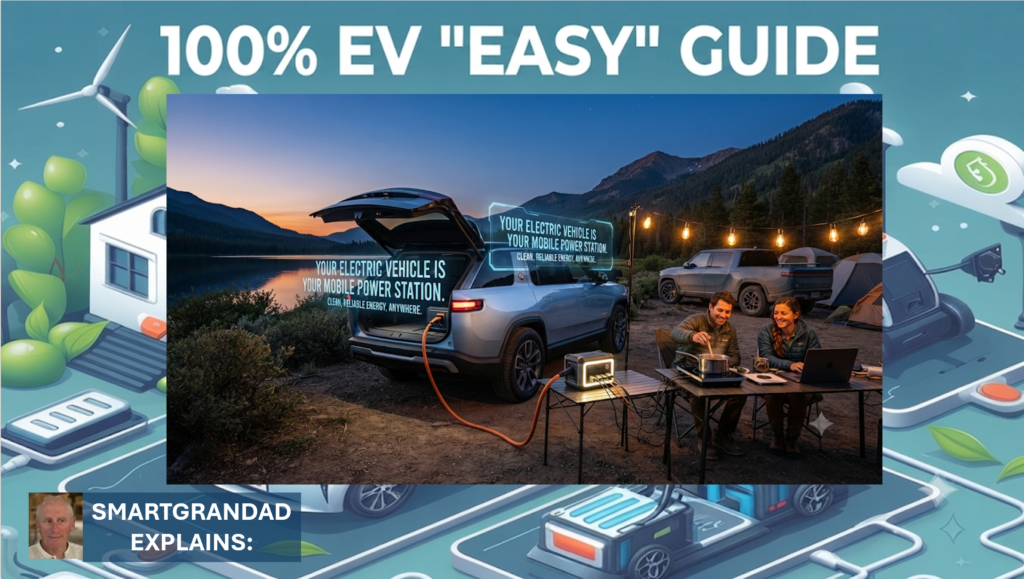
🚗 Rethinking the Electric Vehicle
A Paradigm Shift: For over a century, vehicles have been a one-way street—consuming fuel or electricity for motion. We are now transitioning to bidirectional energy flow, turning electric vehicles (EVs) into highly capable mobile power stations.
The 95% Opportunity: The average car is only driven for about 6 hours a week. For the remaining 162 hours (95% of its life), it sits parked. Because modern EVs are essentially large batteries on wheels, this idle time represents a massive untapped energy opportunity for consumers and the electrical grid
⚡ Decoding Bidirectional Charging
Standard charging takes AC power from the grid, converts it to DC, and stores it in the car. Bidirectional charging uses an advanced inverter to reverse this process, converting stored DC power back into usable AC power. It comes in two primary forms:
Vehicle-to-Home (V2H): This focuses on personal resilience by connecting the vehicle directly to a home’s electrical panel. If a blackout occurs or solar production stops at night, the car automatically serves as a massive home backup battery to keep appliances running.
Vehicle-to-Grid (V2G): This acts as community support. When energy demand spikes (such as around 6:00 PM), cars can communicate with the utility network to loan battery power back to the grid to maintain stability. Utility companies often pay owners for participating.
Virtual Power Plants (VPP): Individual homes plugged into V2G gateways can be aggregated into a central VPP. This allows thousands of parked cars to trade power on energy markets or feed it directly into the distribution network to stabilize national infrastructure
🔋 The Trinity of Benefits
Bidirectional energy introduces three major advantages:
Emergency Backup Power: Provides peace of mind during outages.
Grid Stability: Allows the storage of unpredictable renewable energy (like midday solar or midnight wind) to be dispatched precisely when needed.
Energy Arbitrage: Allows cost savings by charging the EV at night when electricity is cheap and powering the home or selling electricity back to the grid during peak daytime hours when rates are high.
Capacity Comparison: While a standard dedicated home wall battery stores around 10 to 15 kWh, an average EV battery holds between 60 and 100 kWh—making it 3 to 8 times larger. An EV can easily power an average home for 5 to 10 days during a major blackout.
🚘 Vehicles and Global Adoption
Hardware Matrix: The Nissan Leaf pioneered this space using the older CHAdeMO connector. Modern vehicles are adopting bidirectional capabilities using standard CCS ports, including the Ford F-150 Lightning, Kia EV9, and Volkswagen ID models.
The Global Race: Navigating regulatory hurdles is a challenge, but adoption is accelerating globally. Japan and China are utilizing V2G to stabilize their markets, while the US and Australia are running major home backup pilots. Meanwhile, European markets like the UK, Germany, and France are developing profitable frameworks where EV owners earn revenue through grid frequency regulation.