OPINION:
MANY EV CHARGING SITES ARE BETTER THAN PETROL STATIONS
Written by SmartGrandad – BEV enthusiast and BEV owner for over 7 years.
SmartGrandads Opinion
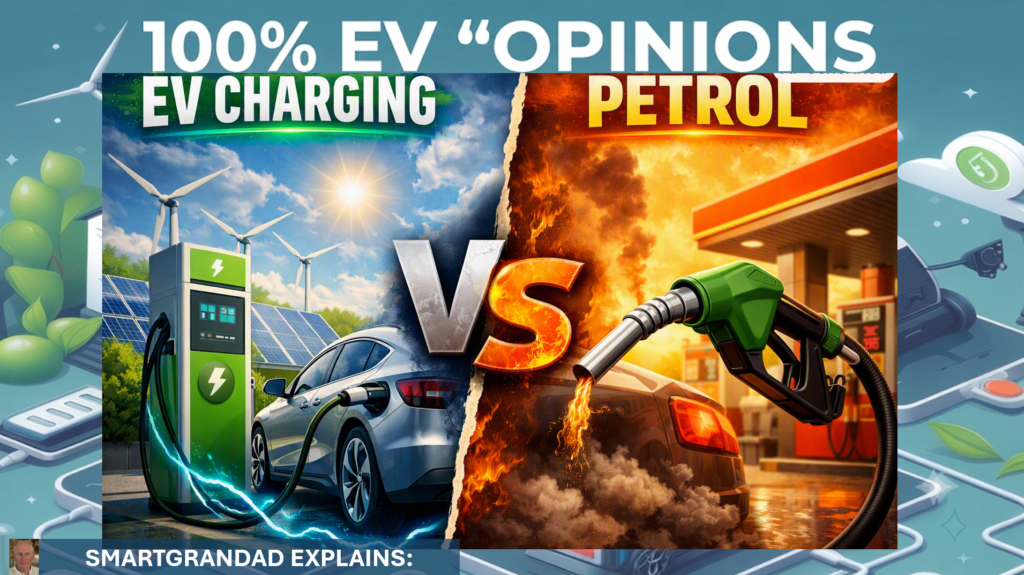
The simple question is: Why are so many EV charging sites simply not as good as standard petrol stations?
If you’ve driven a traditional petrol or diesel car for any length of time, you know the drill. You pull into a well-lit service station, drive under a nice big roof that keeps you dry when it’s pouring rain, swipe your contactless card, grab a warm coffee and a sausage roll, and head on your way five minutes later.
Now, compare that to many public EV charging experiences over the last few years.
You roll into a dark, wind-swept corner of a retail carpark at 9:00 PM. There is no canopy, so you’re standing in the driving rain trying to get a dirty cable to click into your car’s port. To make matters worse, the screen is black or it demands you download a brand-new smartphone app and create an account just to get enough electricity to get home!
Hmm… Lets try and see.
1. How We Got Here: The "Retrofit" Mistake
Around 2012, when electric cars first started hitting the roads, charging infrastructure was treated like an afterthought—a quick addition tacked onto existing car parks.
Big Petrol Giants Wanted EVs To Go Somewhere Else: At the beginning TESLA was forced to setup its own charging network as the petrol giants did not want to see their profits disappear and encourage EVs onto their sites
Suitable Sites & Space Constraints: Throughout Europe (inc Uk.) city and town centres don’t have many sites available and the cost of those that are usually very high. Charging providers squeezed chargers wherever they could acquire the land and where electrical grid connections were cheap and available. That meant dark corners of supermarket carparks, isolated industrial estates or remote patches of countryside.
High Captial Costs & Limited Budgets: Early charge point operators (CPOs) prioritized putting chargers in the ground fast over driver comfort. But, in the early days they opted for just 2 or 6 chargers as at that time the demand was low, unfortunately very short sighted in my view. Installing a full overhead shelter, high-intensity lighting, and amenities costs serious money were luxuries that CPOs thought unnecessary.
The “ EV Route Planning App Craze”: Instead of a simple card reader, every charging network forced drivers to sign up for their own proprietary app or RFID card. Every CPO wanted their own ecosystem and own the customer, therefore we started with no cross compatibility across the CPOs. Again with many App providers chasing few EV Drivers, there we few quality CPO Apps with many supporting only a single Charging Network, which when you are on a long Road Trip makes life very difficult.
2. Big Gaps Between Standards At Petrol Stations And EV Charging Sites
To understand why EV drivers feel shortchanged, we only have to look at four key areas, where petrol stations have had a 70-year head start:
☔ Overhead Protection
Petrol stations cover you from rain, snow, and beating sun. For some reason, early EV site designers assumed electric vehicle drivers loved standing in torrential downpours holding thick, heavy copper cables.
💳 Payment Simplicity and On Site Help
At a petrol pump, payment is painless: pay inside or tap your debit card, credit card. At EV chargers, drivers have historically suffered through no contactless payment terminals, patchy mobile signals, failing app logins and most importantly no ability to go and pay (or even get help) from inside the station.
☕ Amenities & Human Comfort
A 5-minute splash-and-dash at a petrol pump still gives you access to clean facilities, food, hot drinks, and a warm shop. Charging an EV takes 15 to 30 minutes on a fast DC charger—the exact scenario where you need amenities most! Sitting in a dark car park with nowhere to wash your hands or buy a coffee isn’t a premium experience.
🚗 Layout & Accessibility
Petrol stations use pull-through bays. You drive in, pump, and drive out. Most EV chargers were designed as back-in parking spaces. So, if you’re towing a trailer, driving a longer wheel-base van, or have mobility challenges, wrestling heavy cables into tight spaces surrounded by high curbs, in the rain, is a nightmare.
3. The Good News: How Better EV Charging Sites Are Evolving
Times are changing and the tide is turning fast. As EV adoption moves from early tech enthusiasts to everyday families, CPOs realize that poor experiences kill repeat business and fossil fuel stations are realising that to keep their customers they need to provide EV Rapid charging capability on their sites.
Here is how CPOs and fossil fuel stations are actively fixing these problems:
- Traditional Local “Petrol Stations” Adding EV Chargers Regular Petrol stations, are realising that a growing % of customers require electricity instead of fossil fuels. Some like Aril, Total, Shell & BP are installing their own chargers whereas other are working with EV charging partners such as MFG in Uk. to provide the service. In France Driveco and Powerdot, Germany EnBW, IONITY, Mer, and E.ON and Spain Endesa X Way and IONITY.
- Dedicated EV Charging Superhubs Instead of two lonely chargers in a corner, operators like Gridserve, Tesla, Ionity, and Fastned are building dedicated, purpose-built EV hubs. These sites look and feel like luxury petrol stations—featuring
☔ Covered Canopies Solar roofs & bright LED lights
💳 Tap-to-Pay Standard Contactless on all chargers
☕ Lounges & Restrooms Cafes, Wi-Fi, and clean toilets
🚚 Pull-Through Bays Trailer & wheelchair friendly
🔌 Plug & Charge Auto-billing upon plugging in
Generally, these are a huge step up from the traditional facilities at a motorway service station.
- Mandatory Contactless Payments & “Plug & Charge” Regulations across Europe and the UK now mandate clear pricing and contactless payment card readers on all new rapid chargers. Even better, Plug & Charge technology (ISO 15118) is taking over. You simply plug the cable into your car, the charger recognizes your vehicle, and billing happens automatically in the background—no apps, no cards required.
- Wider Pull-Through & Accessible Bays Newer sites are introducing drive-through charging lanes designed specifically for HGV or drivers towing caravans or trailers, as well as wider, curb-free bays for wheelchair users.
SmartGrandad’s Final Thoughts
Bottom Line
The early days of EV public charging were definitely a bit of a “Wild West” situation and we’ve all got a story about standing in the freezing cold fighting with a stubborn charger screen.
As the adoption of EVs increases and the EV Charging industry matures, the era of lonely, unprotected chargers in dark corners is coming to an end.
The future of EV charging isn’t just catching up—with covered solar canopies, high-speed power, plug-and-play simplicity, and comfortable lounges, fingers crossed, it’s going to leave petrol stations in the dust.
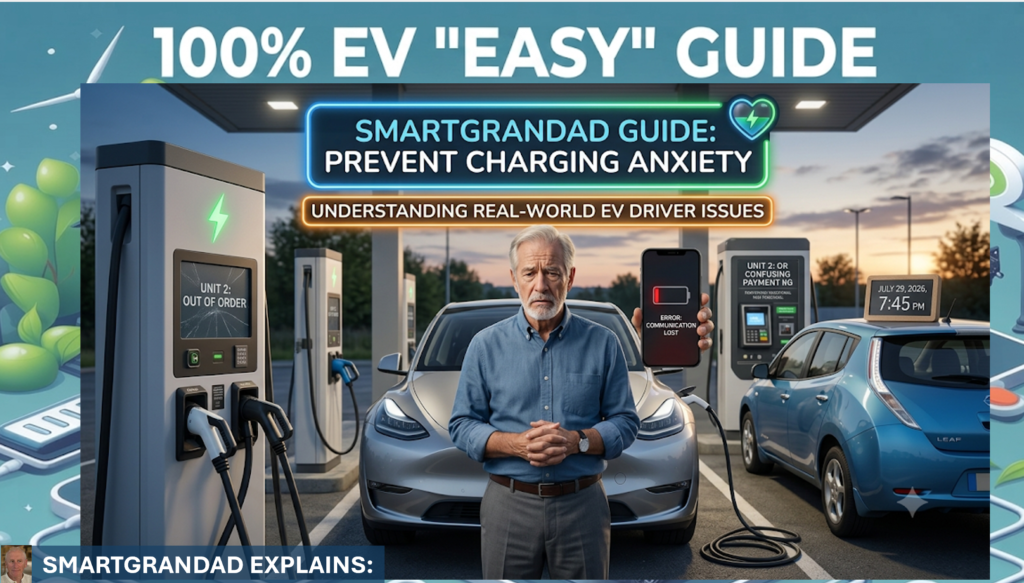
See Also, SMARTGRANDADS 100% EV “EASY” GUIDE 13:
4 WAYS TO PREVENT CHARGING ANXIETY
Whats your view?
Leave your thoughts on this or any other 100% EV topic below.
Written by SmartGrandad – BEV enthusiast and BEV owner for over 7 years.