100% EV “EASY” GUIDE 16:
ULTIMATE 8-STEP EV BUYING GUIDE (2026 Edition)
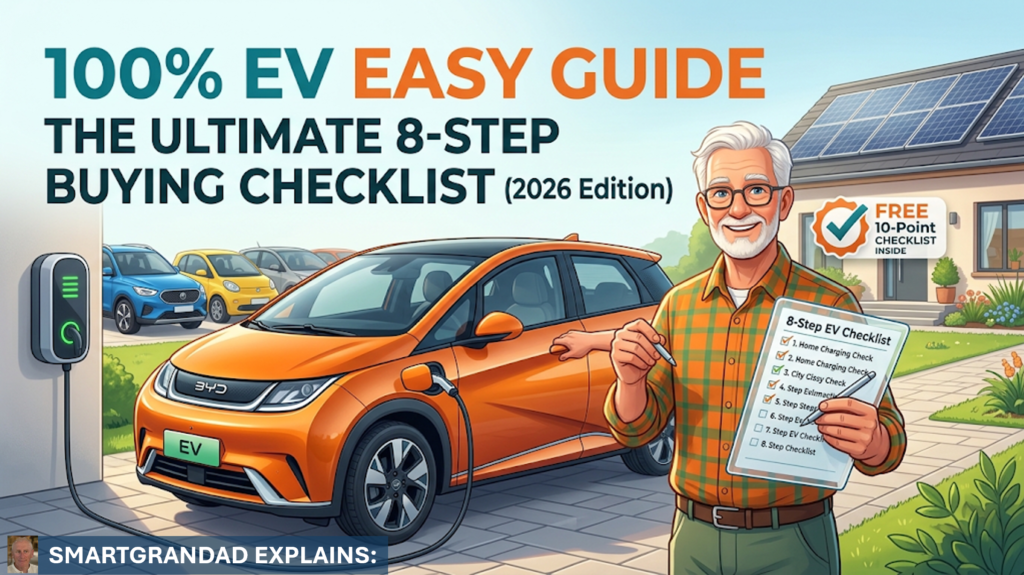
Written by SmartGrandad – BEV enthusiast and BEV owner for over 7 years.
BUYING AN EV - Addressing The Mindset Shift
STEP 1: Matching Range to Your Reality (The 30–60 km Sweet Spot)
Imaginary Worry | Daily Reality |
|---|---|
“I’ll run out of juice on the motorway.” | 95% of trips are well within a single charge; motorways are now lined with chargers. |
“I need 800 km of range just in case.” | Large batteries increase your upfront cost, insurance, and tyre wear. |
“Charging will take all day.” | Home charging happens while you sleep; you wake up with a “full tank.” |
STEP 2: Your Charging Foundation (Home vs. Public)
- Level 1 (Standard Socket): Uses a normal 2.3 kW household plug. It’s slow (10–15 km of range per hour) but fine for emergency top-ups.
- Level 2 (Dedicated Wallbox): The Gold Standard. At 7 kW, it adds 40–50 km of range per hour. You can charge a standard battery from 20% to 80% in about 5–6 hours.
- Level 3 (Public DC Fast Charging): These range from 50 kW to 350 kW. These are your “road trip” chargers, designed to get you back on the road in minutes, not hours.
- Professional Fit: A qualified electrician must install your wallbox and check your home’s load capacity.
- Cost: Expect to pay between €500 and €1,200 (check for local grants that often halve this).
- Smart Tariffs: This is the clever bit. “Smart Chargers” automatically draw power during cheap, off-peak overnight hours, often costing as little as €2 per 100 km.
STEP 3: The Alphabet Soup (Connector Standards & Compatibility)
- EUROPE CCS2: The dominant standard across Europe and much of Asia for fast charging. This is what you’ll find at most public stations.
- NORTH AMERICA NACS: Originally Tesla’s plug, now widely used in North America and appearing on some global exports.
- CHINA /ASIA GB/T: The standard used in China.
STEP 4: Real-World Range & The "Winter Drop"
- WLTP (Europe): Generally realistic but achieved in controlled conditions.
- CLTC (China): Very optimistic; expect real-world range to be 70–85% of this figure.
STEP 5: True Fast-Charging (The Curve vs. The Headline)
- Look for the 10–80% DC rapid charging time. This is the only metric that matters for road trips.
- Also, ensure the car has Battery Preconditioning. A “Smartgrandad tip” for you: set the charger as your destination in the car’s sat-nav. The car will “warm its own belly” on the way, so it’s ready to accept the highest charge speed the moment you plug in.
Tech Level | 10–80% Time | Best Use Case |
|---|---|---|
Standard DC (50-150kW) | 30–45 Minutes | Standard family use, grocery top-ups, 400V models like BYD Atto 3. |
Ultra-Fast (250kW+) | 18–24 Minutes | Frequent motorway driving; 800V models like the Kia EV9. |
STEP 6: Battery Chemistry, Safety, and the "Blade" Story
- LFP (Lithium Iron Phosphate): Think of the BYD Blade Battery. These are cheaper and more ethical because they use no Cobalt or Nickel. They are incredibly durable and safe (passing the “nail penetration test” without fire). LFP batteries actually prefer being charged to 100% regularly.
- NCM (Nickel-Rich): These are lighter and better for energy density (longer range), but they are more expensive and generally prefer a 20–80% daily charging routine to stay healthy.
STEP 7: The Digital Nervous System (Software & Connectivity)
- OTA (Over-the-Air) Updates: Your car can get better while it’s parked, receiving new features or efficiency improvements via the internet.
- Integrated Route Planning: A good system automatically calculates where to stop and charge on a long trip based on real-time charger availability.
- Companion Apps: These are a godsend. You can pre-heat the cabin from your breakfast table, meaning you never have to scrape ice off a windscreen again.
STEP 8: Total Cost of Ownership (The Financial "So What?")
Cost Category | Typical Petrol Car | Typical Electric Vehicle |
|---|---|---|
Upfront Price | Lower | Higher (Gap is narrowing) |
Fuel / Energy | €8 – €14 per 100km | €2 – €7 per 100km (Home Charging) |
Maintenance | Higher (Oil, filters, belts) | Lower (Tyres, cabin filters, brakes) |
Tax / Incentives | Standard rates | Often reduced or exempt |
Resale Value | Predictable | Stabilising; mature models hold well |
Smartgrandad’s 10-Step Pre-Purchase Checklist
- [ ] Battery Capacity: Ask for the “usable” kWh, not the “total” battery size. That’s the energy you actually get to drive with.
- [ ] Check for Heat Pump: Don’t let the salesman talk you out of it; it’s essential for winter range.
- [ ] Confirm Port Location: Check if the charging port is on the side or the nose and ensure it reaches your home charger easily.
- [ ] Test the Route Planner: Enter a long trip into the sat-nav. Does it make charging stops feel easy or a muddle?
- [ ] Check AC/DC Peak Limits: Know the max speeds for both your home wallbox and public rapid chargers.
- [ ] Check Battery Chemistry: Is it LFP (charge to 100%) or NCM (charge to 80%)?
- [ ] Inspect the App: Download the companion app. Is it reliable and fast in your region? Is there a Self Parking function?
- [ ] Warranty Details: Confirm the 8-year battery warranty and the 70% capacity guarantee.
- [ ] FRUNK?: Does this model have a Front Trunk, i.e. separate space to store cables that does not require removing luggage.
- [ ] Battery Health (If Used): Always ask for a “State of Health” (SoH) certificate for any used EV.
2026 Top 10 Selling BEVs in Europe Plus Some Challengers
Europe has a mature and competitive EV market, characterized by strong performance from a mix of domestic and international manufacturers.
Tesla Model Y: Still the dominant force in the European market, holding the crown for its versatility, mature ecosystem, and strong brand presence.
Škoda Elroq: A massive newcomer, this compact SUV has become rapidly popular due to its competitive pricing and practical family features.
Tesla Model 3: Continues to sell strongly, benefiting from a well-received “Highland” refresh and price adjustments.
Renault 5: A stylish, compact, and affordable entry into the market that has quickly built a loyal customer base.
Volvo EX30: A compact premium SUV that has seen significant traction, appealing to those seeking style and Volvo safety at a more accessible price point.
Škoda Enyaq: Maintains its status as a solid family choice, offering a balanced mix of range, space, and comfort.
Volkswagen ID.4: Despite strong competition, the ID.4 remains a key player, especially in markets with established Volkswagen customer loyalty.
BYD Atto 3: The lead vehicle in BYD’s European expansion, appreciated for its price-to-feature ratio.
MG4 EV: An exceptional value proposition that has captured a significant share of the mass-market electric hatchback segment.
Volkswagen ID.3: Continues to be a significant volume seller, appealing to drivers looking for a practical, standard-sized electric hatchback.
Plus a couple of models that are definitely worth a good look!
- BYD Dolphin: A compact hatch that offers incredible city value and a practical size for daily commuting.
- Kia EV3; Refined compact SUV with 7 year warranty, ideal for city and daily communtes.
- BYD Seal 7: is a sleek, dynamic mid-size sedan offering incredible value.
- KIA EV6: Still the Benchmark for Long Distance, Reliable and Stylish travel
- XPENG G9P: Ultra fast charging luxury cruiser, with super tech, especially competent “Self Parker”.
- VW ID.7 Tourer: Spacious motorway cruiser.
SmartGrandads Final Thoughts
SmartGrandad Would Love To Hear Your Views.
Written by SmartGrandad – BEV enthusiast and BEV owner for over 7 years.