100% EV “EASY” GUIDE 20:
How to Master Long-Distance EV Road Trips – 3 Essential StepsNEW
Written by SmartGrandad – BEV enthusiast and BEV owner for over 7 years.
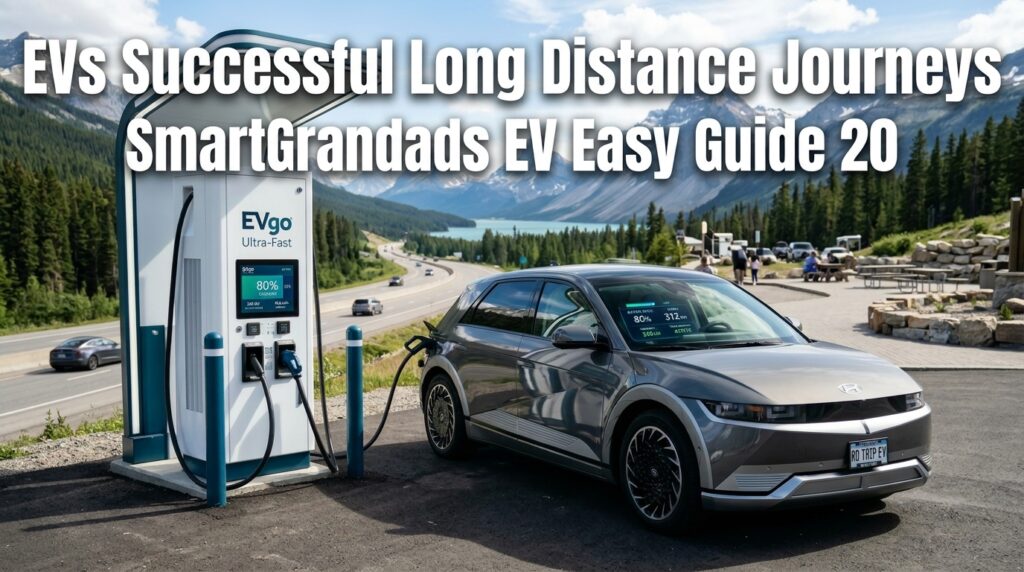
How EV Owners Conquer Long Road Trips
Mention taking a 600-mile (1,000 km) road trip in a pure electric vehicle to a fossil-fuel driver, and you’ll often be met with wide eyes and tales of endless waiting at side-of-the-road charging posts.
But speak to experienced EV drivers, and they’ll tell you a completely different story: long-distance electric travel isn’t just easy—it’s frequently more relaxed, cheaper, and far less stressful than driving a petrol or diesel car. The secret doesn’t lie in sitting by a charger waiting for 100% full capacity; it comes down to understanding battery physics, leveraging smart route planning, and letting your car do the heavy lifting while you enjoy a quick coffee.
Here is the plain-English, jargon-free guide on how real EV owners conquer long road trips—and what you need to look out for when buying your next electric car!
3 Steps to ensure that Long EV Road Trips are Stress Free.
1. Choose an EV with the Right Features
2. Plan Your Route with On The Go Rapid Chargers and Overnight Stops with Destination Chargers
3. Optimise the Range/ Charging Capabilities & Costs during Trip
Step 1. Choose an EV with the Right Features
Bear in mind that just as with Fossil vehicles, different EV Models have different strengths and weaknesses.
If like me, you want your EV to have the best ability to cover large distances in a day, you need to select models that have those features.
Below, are the key features that are essentials for your long journeys;
– Good Official (WLTP) Range:
- Aim for long-range vehicles with official ratings of 300 to 520+ miles (500–837 km) (e.g., Lucid Air, Tesla Model S/3/Y, Mercedes EQS) to preserve a comfortable range buffer at highway speeds.
- Note: There are different rating systems that give vastly different results.
- Most Accurate: EPA (United States) Real-World Rating: ~90%–95% of real-world driving.
Global Baseline: WLTP (Europe & International) Real-World Rating: ~80%–85% of real-world driving.
Least Accurate: CLTC (China) & NEDC (Legacy European) Real-World Rating: ~65%–75% of real-world driving.
– 800V EV Platform Architecture:
An 800-volt (800V) architecture is widely considered the modern benchmark for high-performance and long-distance electric vehicles, moving beyond the industry’s traditional 400V standard.
The main advantage comes down to a fundamental principle of electrical engineering (P = V × I): by doubling the voltage, a vehicle can deliver or draw the same amount of power using half the electric current.
- With 800v, the time spent charging is drastically reduced, e.g. charging 10%-80% is probably going to be under 20 mins.
– Heat Pumps:
- Choosing a vehicle equipped with a heat pump (rather than standard electrical resistance heating) significantly reduces winter range degradation by moving ambient heat into the cabin 2 to 4 times more efficiently.
Using Smartgrandads 100% EV Model finder and use the “Platform Voltage” and “Range” filters to shortlist the models that are setup for Long Road Trips.
Step 2. Plan Your Route with On The Go Rapid Chargers and Overnight Stops with Destination Chargers in Mind
Before your journey, take a few minutes and use Google Maps and Apps like Tesla and Ionity to plan your route and understand what Rapid / Destination Chargers are available. Try Smartgrandads AI Journey Planner prompt in Smartgrandads EV “Easy” Guide 19.
Some of the latest EV models have really good navigation systems which can plan almost instantly your route and charging stops. Note. Although you will be given charging options that may not be very cost effective.
– DC RAPID Charger Density along your Route:
- Ensure primary driving routes feature robust networks of 150–350 kW DC fast chargers at motorway service plazas rather than slower AC Level 2 chargers.
– AC Chargers At Overnight Stops:
- The best Road Trip time saver is to charge whilst you are sleeping and start the day with a battery at 100%.
Note: Public Charging Costs:
- DC Rapid charging on highway corridors can carry significantly higher costs. My advice is to use membership deals (like Ionity Power) that can say up to 50% of the cost for a small monthly cost.
- AC charging at hotels are usually much cheaper than standard Rapid chargers, but always good to check before you book.
STEP 3. Optimise the Range/ Charging Capabilities & Costs during Trip
Steps 1 & 2, ensure that you have the best EV and Plan for your Road Trips.
But during the journey, there are still things that you can do to optimise each days driving and to adjust to events like your speed, road closures, changes in weather and your rest needs.
– Start 100% Battery
- Modern EV batteries can be charged to 100%, so make sure that you start the journey with the best possible range.
– 80%-90% Rapid Charging Limit
- DC Rapid chargers (150–350 kW) can replenish an EV battery from near-empty to 80% in 15 to 20 minutes. Because charging speeds slow dramatically above 80% to protect battery health and prevent thermal damage, long-distance drivers rarely wait for a 100% charge.
- Aligning Stops with Rest Breaks: Drivers schedule 20- to 30-minute charging sessions every 2 to 3 hours to coincide with natural meal, coffee, or bathroom breaks.
– Planning for Real-World Highway & Weather Efficiency Drops
- Highway Speed Drag: High-speed highway cruising causes electric motors to run less efficiently while encountering higher aerodynamic drag, resulting in real-world highway ranges averaging 13% to 26% below window-sticker figures.
- Cold Weather Losses: Temperatures below -6.7°C (20°F) reduce EV range by 12% to 41% due to sluggish battery chemistry and the electrical energy required to heat the cabin.
– Charging Apps & Navigation Tools
- Live Route Planning: Drivers rely on navigation tools and apps (such as Zap-Map) to verify real-time charger availability, charging speeds, and plug status before arriving.
👴 SmartGrandad’s Key Take-Aways
– Choose an EV with the right Long Distance Features:
- If you EV does not have 800v and a Good Official Range when you buy, you are stuck as you will not be able to upgrade these things later on.
- Check out the Charging Speed and Curve, so that you get 15-20 min recharges.
– Use EPA & WLTP Range Numbers:
- Remember that Official range stickers can be generous. Always build in a 15–30% safety buffer for highway driving speeds and colder weather. Its better to have one more planned stop, than be left on the side of the road with 0%.
- Check your models range using Smartgrandads 100% EV Model finder
– Skip Charging Over 90%:
- Start each day with a battery charged to 100%. Never waste time waiting for a 100% charge at a motorway fast charger! Charge quickly to 80%-90% in 15–20 minutes, grab a coffee, and get back on the road.
– Do the Planning /RePlanning of your Road Trip:
- Plan new routes BEFORE you leave using Google Maps, Ionity, Tesla and other Apps. Replan as soon as changes happen along the way.
- Adjust your driving to match the amount of range remaining as there is a large impact from drag when at high speeds.
Whats your view?
Are you thinking about picking up a secondhand EV, or are you still sitting on the fence about battery life and depreciation? I’d love to hear your thoughts and experiences—leave a comment below or send me a message!
Written by SmartGrandad – BEV enthusiast and BEV owner for over 7 years.