100% EV “EASY” GUIDE 22:
Top 10 Tips for Mastering Winter EV DrivingNEW Duplicate
Prefer a Short Video?
Written by SmartGrandad – BEV enthusiast and BEV owner for over 7 years.
Driving an electric vehicle (EV) through the winter months offers a quiet, smooth, and highly responsive experience. However, cold weather introduces unique operating dynamics that every driver should understand. Ambient cold temperatures influence battery chemical activity, cabin heating demand, tire pressure, and charging speeds. Having driven several 100% EVs through 5 scandinavian winters I have put together 10 TOP TIPS for WINTER EV DRIVING.
The Cold Weather EV Maths
Far from being a reason to fear winter driving, these factors are easily managed with simple habits and practical preparation.
Independent research by AAA Automotive Engineering reveals that operating an EV in 20°F (-7°C) weather with cabin heating running results in an average range reduction of roughly 39% compared to a mild 75°F (24°C) baseline. However, low temperatures alone—acting strictly on battery chemistry without cabin heating—account for only a 12% range drop. The vast majority of winter range loss stems directly from heating the interior.
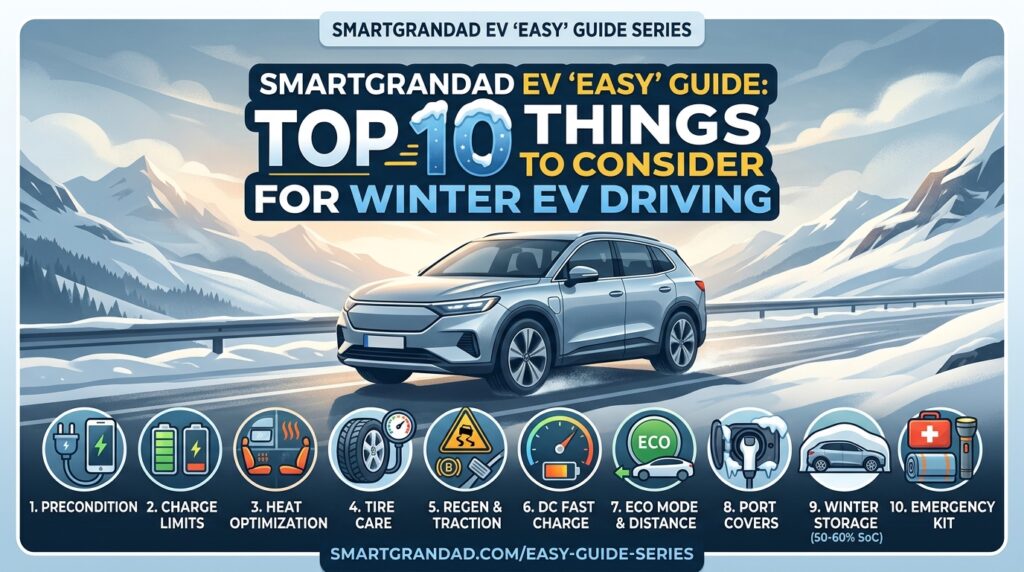
Below is the definitive SmartGrandad EV Easy Guide, outlining the top 10 actionable strategies to maximize your range, protect battery health, and stay warm all winter long.
Tip 1. Precondition the Cabin and Battery While Plugged In
Preconditioning warms both the interior cabin and the high-voltage battery pack before you set off. Using your vehicle’s mobile app or onboard touchscreen menu, set a scheduled departure time while your EV remains connected to your home charger.
- Save Main Battery Power: Drawing preconditioning power directly from the electrical grid preserves 15% to 20% of your battery’s total capacity for the road (as documented by Road Ethos and Octopus EV).
- Unlock Efficiency Early: A pre-warmed battery pack reduces internal electrical resistance, immediately unlocking full regenerative braking capability and standard energy efficiency upon departure.
- Garage Safe: Guidance from the U.S. Department of Energy emphasizes that preconditioning in an enclosed garage is 100% safe, as EVs emit zero toxic tailpipe exhaust fumes.
Tip 2. Managing Your Batteries State-of-Charge (SoC)
Managing your battery’s State of Charge (SoC) during cold snaps protects long-term cell health and ensures reliable starting power.
- Keep It Plugged In: Vehicle manufacturer guidelines and Safe Electricity recommend keeping your EV connected to home power when parked in freezing weather. The vehicle’s Battery Management System (BMS) will use low-level grid power to maintain safe battery temperatures and keep the 12V auxiliary battery topped up.
- Avoid Storage at Extremes: Storing a lithium-ion pack at 100% SoC creates prolonged chemical stress that accelerates degradation, while leaving it near 0% risks deep discharge damage. Set daily winter charge limits to 80% for daily driving, or 50%–60% for extended storage (Auto VIP).
Tip 3. Optimize Cabin Heating: Heat Pumps vs. Resistive Heaters
Unlike internal combustion engines (ICE) that utilize abundant waste heat from burning fuel, EVs generate cabin warmth directly using electrical power from the battery. The technology your car uses plays a major role in winter efficiency and can save you 8% of your range:
| Heating Technology | Operating Mechanism | Energy Efficiency Ratio (COP) | Winter Range Retention (Freezing Temps) |
| Resistive Heater | Converts electricity directly via heating coils (draws 3–5 kW) | 1:1 (1 unit heat per 1 unit electricity) | ~75% Range Retained |
| Heat Pump | Extracts thermal energy from outside air and transfers it inside | 3:1 to 4:1 (3–4 units heat per 1 unit electricity) | ~83% Range Retained |
Data compiled by Road Ethos & Recurrent across 30,000+ EVs.
Use Seat & Steering Wheel Heaters
To stretch range even further, prioritize heated seats and a heated steering wheel over blasting central climate control. Surface heaters warm your body directly via thermal conduction, consuming only a fraction of the power required to heat the entire volume of cabin air.
Tip 4. Maintain Correct Cold-Weather Tyre Pressure & Tread Depth
Cold air causes tyre pressure to drop naturally by approximately 1 to 2 PSI for every 10°C (18°F) drop in ambient temperature. Because EVs carry heavy battery packs and deliver instant motor torque, proper tyre maintenance is essential for safety and range.
The Cost of Underinflation (Michelin Canada Data)
- Higher Rolling Resistance: Underinflated sidewalls flex more, forcing motors to draw more energy and reducing range.
- Accelerated Wear: Heavy EV battery loads stress tire shoulders, speeding up outer edge tread wear.
- Compromised Handling: Low pressure degrades steering precision and lengthens stopping distances on slick pavement.
Key Tyre Maintenance Rules
- Check Pressure Monthly (Cold): Measure pressure when tires have been parked for at least 3 hours. Inflate to the PSI listed on your vehicle’s driver-side door jamb placard.
- Rotate Every 8,000 to 12,000 km: Evenly distributes wear across all four tyres under heavy torque loads.
- Inspect Tread Depth: Replace tyres when tread reaches 2/32 of an inch (visible wear indicator bar).
- Use EV-Ready Winter Tyres: Dedicated winter tyres with High Load (HL) or Extra Load (XL) ratings provide superior cold-weather rubber compounds, improved grip, and optimized rolling resistance.
Tip 5. Adjust Regenerative Braking & One-Pedal Driving on Slippery Roads
Regenerative braking recharges your battery while slowing the car, but slippery conditions require active driver intervention (Lacombe Quick Lane EV guidance).
Safety Alert for Icy Roads: Aggressive regenerative braking applies strong, immediate deceleration force to the driven wheels when lifting off the accelerator. On black ice or packed snow, this sudden drag can cause wheels to lose traction and skid.
- Lower Regenerative Intensity: Switch regen settings from High to Medium or Low when roads are covered in snow or ice.
- Disable One-Pedal Driving: Turning off one-pedal mode restores manual control over deceleration, allowing smooth, progressive braking via the physical foot pedal.
- Anticipate Stops Early: Begin slowing down much earlier to prevent lock-ups on low-friction surfaces.
Tip 6. Pre-Warm the Battery for Fast Charging & Follow the 80% Rule
Cold temperatures thicken a lithium-ion battery’s liquid electrolyte, slowing ion movement and causing public DC fast chargers to drastically throttle charge speed to prevent battery damage.
How to Speed Up Winter Public Charging
- Use Built-in Sat Nav Preconditioning: Setting a public fast charger as your destination in your EV’s native navigation system automatically triggers battery pre-warming en route (Osprey Charging / Octopus EV).
- Manual App Trigger: If using Apple CarPlay or Android Auto for navigation, manually activate battery preconditioning via the vehicle’s touchscreen 20 to 30 minutes before arrival.
- Plug in Warm: Charge immediately after finishing a journey while the battery is naturally warm from driving.
- Stop at 80% SOC: The charging curve slows down significantly between 80% and 100%. Stopping at 80% saves time, cuts costs, and frees up infrastructure.
Tip 7. Adopt Smooth Driving Techniques & Engage Eco Mode
Instant electric motor torque is fantastic for responsiveness, but slippery winter roads demand extra moderation.
- Progressive Throttle: Apply smooth, gentle pressure to the accelerator to prevent wheel spin.
- Engage Eco Mode: Eco mode dampens throttle sensitivity, optimizes torque delivery, and reduces heavy climate control draws automatically.
- Increase Following Distance: Stopping distances on ice can be up to 10 times longer than on dry pavement (Octopus EV). Maintain generous buffers between vehicles.
Tip 8. Protect Outdoor Charging Equipment & Ports Against Freezing
Charging hardware withstands wet weather easily, but freezing rain and ice can freeze port doors and cable latches shut.
- Use Magnetic Port Covers: A waterproof cover shields your charge port and connector inlet from sleet and freezing rain (U.S. Department of Energy).
- Clear Snow First: Brush away loose snow around the charging door before opening or plugging in.
- Stow Cables Off the Ground: Hang cables neatly on wall mounts when idle to prevent connectors from freezing into ground ice.
Tip 9. Follow Specialized Protocols for Winter EV Storage
Leaving an EV parked for weeks or months requires a different approach than traditional petrol or diesel cars (Auto VIP storage protocols):
- Keep Plugged In: Leave the car connected to a Level 1 or Level 2 charger so the vehicle can draw grid power to maintain high-voltage battery temperature and top up the 12V battery.
- Set Storage Charge Limit: Cap maximum charge between 50% and 60% (the ideal chemistry stability range).
- Disable Phantom Drain Features: Turn off Sentry Mode, proximity security monitoring, and Cabin Overheat Protection.
- Over-Inflate Tyres: Increase tyre pressure above normal to prevent flat-spotting under the car’s weight.
- Disengage Electronic Parking Brake: Use wheel chocks instead of engaging the parking brake for extended periods, preventing brake pads from fusing to the brake discs.
Tip 10. Pack an EV Winter Emergency Kit & Plan Route Buffers
When planning winter road trips, account for cold-weather range reductions by building safety margins into your navigation.
Trip Buffer Strategy
- Plan Stops at 20% Remaining State of Charge: Schedule charging stops so you arrive with at least a 20% battery reserve. This buffer protects against unexpected detours, strong headwinds, or intense heater usage.
- Use Dedicated EV Apps: Plan routes using tools like Electroverse or A Better Routeplanner (ABRP) for live station status updates.
Recommended EV Winter Emergency Kit
Keep these essential items stored in your trunk:
- De-icer spray and a heavy-duty ice scraper.
- High-visibility torch/flashlight with extra batteries.
- Thermal blankets, heavy winter clothing, and gloves.
- First aid kit and non-perishable food/water.
- Portable magnetic charge port cover.
Quick-Reference Winter EV Maintenance Checklist
| Frequency | Maintenance Task | Primary Benefit |
| Daily / Departure | Schedule cabin & battery preconditioning while plugged in | Preserves 15%–20% range; ensures a warm cabin |
| Monthly | Check cold tire inflation pressure with a manual gauge | Restores optimal rolling resistance; prevents outer shoulder wear |
| Monthly | Inspect charge port door, rubber seals, and outdoor cables | Prevents moisture ingress and frozen locking pins |
| Every 8,000–12,000 km | Rotate tires and inspect tread depth across full width | Maximizes tire lifespan under heavy battery weight and instant torque |
| Pre-Winter Seasonal | Top up windshield washer fluid with low-temp winter mix | Prevents fluid freezing and clears harsh road salt |
| Long-Term Storage | Keep plugged in, set SoC limit to 50%–60%, disable Sentry Mode | Preserves high-voltage cell health; prevents 12V drain |
What Are Your Winter EV Hacks?
Are you driving an EV through its first cold season, or do you have a battle-tested routine for sub-zero temperatures?
I’d love to hear your thoughts and experiences—leave a comment below or send me a message!
Written by SmartGrandad – BEV enthusiast and BEV owner for over 7 years.
SG UPDATES / CORRECTIONS
Although I try hard to have accurate and up to date information, please let me of any corrections / improvements that are required, using the SmartGrandad Contact Form below. (include the post URL).
Thankyou Smartgrandad
Tagged POSTS