OPINION:
Thinking of Buying a Chinese BEV? 5 Things to Know FirstNEW
Written by SmartGrandad – BEV enthusiast and BEV owner for over 7 years.

Thinking of Buying a Chinese EV? 

If you have been shopping for an electric vehicle lately, you have almost certainly noticed the shift. Lots of Chinese Battery Electric Vehicles (BEVs) are landing in Western showrooms with eye-catching designs, high-end standard equipment, and prices that undercut legacy domestic models by thousands. For many buyers, the temptation to place a deposit is immediate.
 
Yet, that excitement is often met with a lingering hesitation, uncertainty and a fear of the unknown. Questions about long-term reliability, software polish, battery lifespan, and spare-parts availability make taking the plunge feel like a gamble into the unknown. How do you separate aggressive export marketing from the real-world ownership experience?
 
As an owner of a Chinese BEV (XPENG G9P) for 2.5 years, I will weave in my experiences into the TOP five realities every buyer in Europe and North America must evaluate when buying a Chinese BEV.


1. Don’t Assume Big Sales Volume Means Top Quality: The BYD Paradox

When a manufacturer dominates global EV production statistics, it is easy to assume their mass-market vehicles lead the industry in initial build quality. However, market scale does not automatically guarantee flawless execution across every trim and model.
 
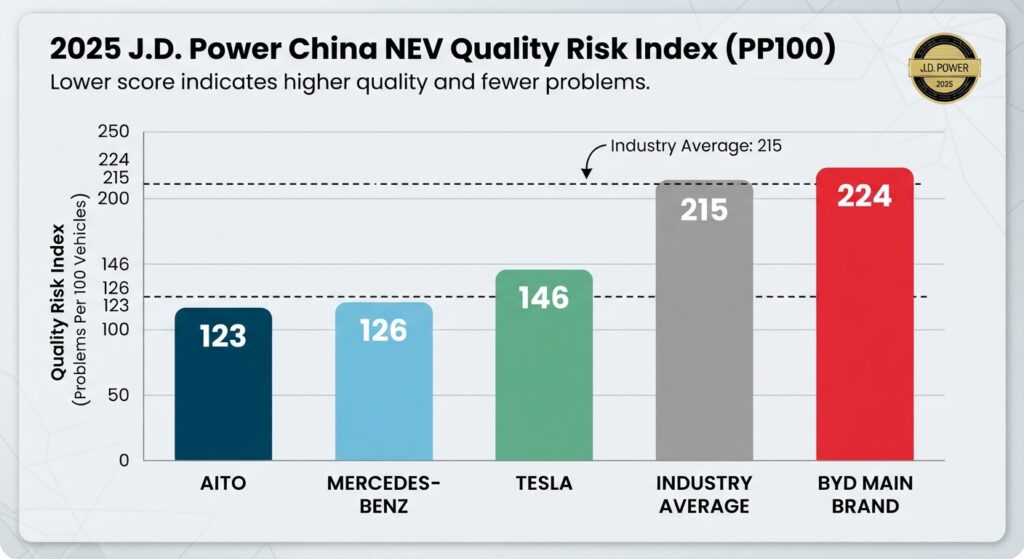
According to the 2025 J.D. Power New Energy Vehicle (NEV) Product Quality Index in China—which surveyed over 5,700 vehicle owners across 57 brands—the main BYD brand registered a Quality Risk Index score of 224 (where a lower score indicates fewer problems and higher quality). This placed the main BYD brand below the industry average score of 215.
 
By contrast, premium niche brands and top-tier performers scored significantly better on the index:
  • Huawei’s Aito: Ranked #1 overall with a market-leading score of 123
  • Mercedes-Benz: Ranked #2 with a score of 126
  • Tesla: Ranked #3 with a score of 146
  • BYD Sub-Brands (Denza & Fang Cheng Bao): Scored 210 and 208 respectively, beating the industry average
Smartgrandad’s Analysis

Why does this paradox exist? Rapid manufacturing scaling and high-volume model rollouts can put immense pressure on baseline quality control for entry-level models. Interestingly, specific individual models within BYD’s lineup—such as the BYD Seal 05 EV, Atto 2 (Yuan UP), and Atto 3—rank inside the top five for initial quality within the compact/mid-size SUV segment. Global volume figures tell you a brand is popular, but individual model quality rankings tell you whether your daily drive will be headache-free.

2. Software and Ergonomics Have Replaced Mechanical Defects as the #1 Quality Risk

When legacy car buyers worry about electric vehicles, they usually picture electric motor failures or catastrophic battery meltdowns. However, quality metrics from real-world owner studies show that traditional mechanical systems have matured rapidly.
 
The 2026 J.D. Power China New Energy Vehicle Initial Quality Study (NEV-IQS)—based on 21,177 vehicle owners—revealed that industry growth in traditional defects and mechanical malfunctions dropped to 0%. Instead, design-related problems account for nearly 70% of all reported quality issues. 
 
The largest pain points stem directly from cabin electronics and driver assistance:
  • Infotainment Systems: Account for 14.3% of all reported problems (the single largest issue category for three consecutive years). Common complaints center on unresponsive touchscreens and dropped Bluetooth connections.
  • Advanced Driver Assistance Systems (ADAS): Account for 9.5% of problems, with drivers citing overly aggressive reverse parking alerts, camera lens soiling, and inaccurate system performance.

Smartgrandad’s Analysis

This data confirms a major shift in modern automotive ownership: you are far less likely to be stranded by a broken powertrain than you are to be frustrated by daily software bugs and clunky menu design. For instance, in the UK’s Auto Express Driver Power 2026 survey, MG placed 29th out of 30 brands with an 81.11% satisfaction score.
 
The primary driver of owner dissatisfaction was not mechanical breakdowns, but complaints surrounding MG’s iSMART infotainment software. When test-driving a Chinese BEV, prioritize testing localized screen responsiveness, system menu logic, and phone integration stability. 
 
Design-related problems, often to meet latest legislation,  represent as high as 70%. Therefore, optimizing the interactive experience and accuracy of intelligent functions has become a core priority in automotive quality management.
 

3. Batteries Warranties Are Mostly Similar , Vehicle Warranties Vary Significantly

Battery Technology

If there is one area where Chinese EV manufacturers hold a genuine structural advantage, it is battery chemistry and cell architecture. Lithium Iron Phosphate (LFP) technology, such as BYD’s Blade Battery, offers exceptional thermal stability and durability, handling over 3,000 charge/discharge cycles—the equivalent of up to 1.2 million kilometers (around 745,000 miles) of total service life.

To capitalize on this, BYD upgraded its European Blade Battery warranty to 8 years or 250,000 km (155,300 miles) at a minimum 70% State of Health (SOH). Crucially, this move was applied automatically and retroactively to existing European owners. By comparison, standard European rivals, Volkswagen’s ID. series, and base rear-wheel-drive Tesla Model 3 and Model Y variants stick to an 8-year or 160,000 km (99,400 miles) limit, while Tesla Long Range/Performance models cap out at 192,000 km (119,300 miles).
 
Furthermore, in China the national standards governing battery health transparency, cover:
  • State of Certified Energy (SOCE): The displayed battery health inside the car or on its companion app must be accurate within 5% of actual remaining capacity.
  • Auxiliary Usage Display: Non-driving energy consumption must be converted into a “virtual mileage” reading accurate within 3%.
  • Mandatory Durability Baseline: High-voltage batteries must retain at least 82% health after 5 years or 100,000 km of driving.

Vehicle Reliability

When looking purely at non-battery components—such as the chassis, drivetrain, interior assembly, and mechanical hardware—Chinese manufacturers have largely caught up to traditional European and American automakers in basic mechanical engineering and build quality. However, traditional and established manufacturers still retain an edge in software ecosystem maturity, long-term real-world track records, and local service infrastructure.
Warranty Summary

 
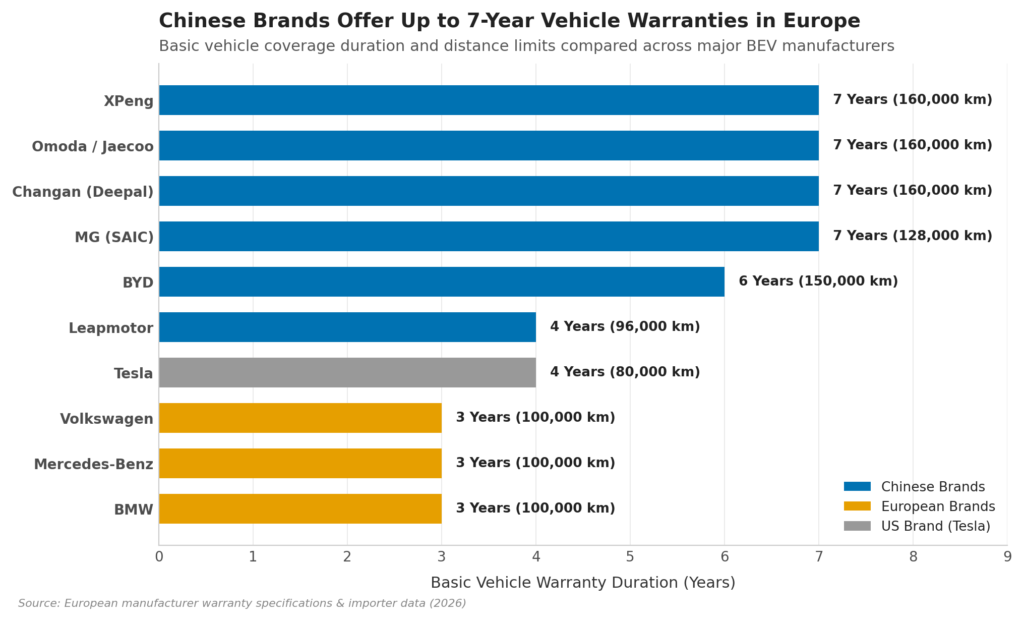
Use the table below to see the variations between a selected set of manufacturers. 
 
Brand
Vehicle Warranty
Battery Warranty
UK Service Network
Fine Print & Key Exclusions
BYD
6 Years / 150,000 km (~93,750 mi); Drive Unit: 8 Yrs / 150,000 km
8 Years / 250,000 km (~155,000 mi), min. 70% SOH
~140 sites (110+ full dealerships)
Battery cover extended retroactively in 2026; 12-yr unlimited-mileage anti-perforation cover.
MG
7 Years / 80,000 miles (unlimited mileage in Year 1)
8 Years / 100,000 miles, min. 70% SOH
180 service centres
Wear items (brakes, bulbs, fuses) restricted to 12 mos / 15,000 mi. 7-yr anti-perforation cover.
Omoda
7 Years / 100,000 miles
8 Years / 100,000 miles, min. 70% SOH
130+ dealer & service locations
Includes up to 7-yr RAC roadside assistance tie-up if serviced at official dealer. (4 Yrs / 80k mi for commercial use).
Jaecoo
7 Years / 100,000 miles (no cap for first 3 Yrs)
8 Years / 100,000 miles, min. 70% SOH
130+ dealer & service locations (shared with Omoda)
Includes 12-year body anti-perforation cover.
Leapmotor
T03: 3 Yrs / 60,000 mi; B10 & C10: 4 Yrs / 60,000 mi
8 Years / 100,000 miles (all models)
~79 UK retailers (via Stellantis network)
Shortest vehicle warranty among major Chinese export brands; backed by Stellantis parts logistics.
XPeng
7 Years / 100,000 miles
8 Years / 100,000 miles
20+ service centres
Includes 12-year body anti-corrosion cover with no mileage limit.
Changan
7 Years / 100,000 miles
8 Years / 120,000 miles (EV models)
60+ locations
Extended battery mileage limit (120k mi) on pure EV models.

Smartgrandad’s Analysis

Battery technologies are reliable, but are still developing rapidly in terms of;

– Charging Speeds, advanced technologies can now offer extremely rapid charging in under 10 mins!
– Safety, eliminating the risk of fire happening when the battery is punctured.
– Range, increasing the distance you can go for every KW.
so, check carefully that the model that you choose is not going to receive a battery upgrade in the near future.
 

Vehicle Quality & Reliability is where traditional manufacturers, in general, still have a slight lead.

Again check carefully regarding the manufacturer and model as the Chinese are catching up fast and in some cases can be overtaking the traditional makers. 
 
So far, in 2.5 years with the XPENG G9P, I have not had one problem that has required fixing and having 7-8 year vehicle / battery warranty give a lot of peace of mind. My experience  is that with multiple OTA updates the car has improved dramatically since 2024.
 

4. Service Network & Parts Supply Chains

A common misconception among first-time buyers is that a vehicle’s country of origin dictates its long-term reliability. In reality, long-term satisfaction is a trust issue, not a manufacturing question. A minor component failure becomes a major crisis if there is no local dealer to diagnose it or if replacement parts take months to arrive from overseas.

Day-to-day dependability depends heavily on how near your nearest dealer is and how quickly a vehicle can be serviced or repaired:

  • Established volume brands like MG (180 service centres in the UK) and BYD (~140 UK sites with regional parts warehouses) have built dedicated local infrastructure.
  • Partnership brands like Leapmotor utilize established legacy networks (serviced directly through Stellantis’s dealer and distribution network).
  • Newer or lower-volume entrants (such as XPeng or Changan’s Deepal) have smaller service footprints, which can lead to longer lead times if replacement parts need to be shipped directly from China.

Smartgrandad’s Analysis

Overall, in your particular location, you may be lucky and have a service center nearby or in worst case you may have a 2 hour journey to get service. But check carefully where the service centre is and how quickly the manufacturer is adding locations.

5. Long Term Depreciation & Resale Value

Because many Chinese BEV brands have only been operating in European export markets for a few years, long-term 8-to-10-year reliability and resale data remains slim meaning that it is almost impossible to accurately predict vehicle resale values.
 
New BEVs are often Leased by companies who are not so sensitive to unpredictable depreciation or sudden pricing adjustments can impact the total cost of ownership over a typical 3-to-5-year period. For 2nd hand buyers in Europe or North America, the existence of dealers and service centers are even more important, as it increases the trust in the Chinese manufacturer. Long vehicle warranties access to parts also factor into resale values.

Smartgrandad’s Analysis

Chinese & Traditional manufacturers vehicles resale prices and reliability are subject to many factors.
 

Smartgrandads Checklist:

There are many that you can check into, e,g;
– Visit an actual Dealer and take a long test drive, then ask question about servicing and parts
– Online Dealer websites 2nd hand vehicles sales lists
– Online vehicle websites e.g. autotrader.com, etc.
– Social Media Owners Forums where you see what other owners are discussing.
– Use AI where you can do multiple broad and narrow searches on things like known issues, customer satisfaction, etc..


Smartgrandad’s Opinion

Whilst BEVs industry is not yet mature, we are well past the “early Adopter” stage. The volumes of sales and service centres are expanding rapidly, bringing with it knowledge and 2nd line industry support.
 
In 2026 and forward, buying a Chinese electric vehicle in Europe or North America is no longer a high-stakes gamble on unproven battery hardware or structural safety. Chinese LFP battery technology, crash testing standards, and manufacturing scale are world-class—backed in several cases by market-leading 250,000 km battery warranties.
 
The true test of long-term satisfaction lies entirely in the human-machine interface and the regional ownership ecosystem. Are you getting a polished digital interface with reliable over-the-air updates, or an annoying touchscreen with buggy software? Is the manufacturer backed by hundreds of local service bays and local parts distribution hubs, or a thin import network?
 
The Bottom Line:
 
Don’t buy on sticker price and battery specs alone. Test the infotainment system extensively in your native language, verify the proximity of your nearest service center, and read the warranty exclusions carefully and Use Smartgrandads Buying Checklist (above)
 

Whats your view?

 I’d love to hear your thoughts and experiences—leave a comment below or send me a message!

Written by SmartGrandad – BEV enthusiast and BEV owner for over 7 years.

5 1 vote
100% EV Model / Article Rating
0 Comments
Oldest
Newest Most Voted

Thankyou For Visiting Smartgrandad.com

Smartgrandads Long EV Journey Planner

Plan your Charging Stops plus any Overnight Stays and more… Click Button Below