100% EV “EASY” GUIDE 11:
No Driveway – 5 Truths About Charging At Home in Uk.
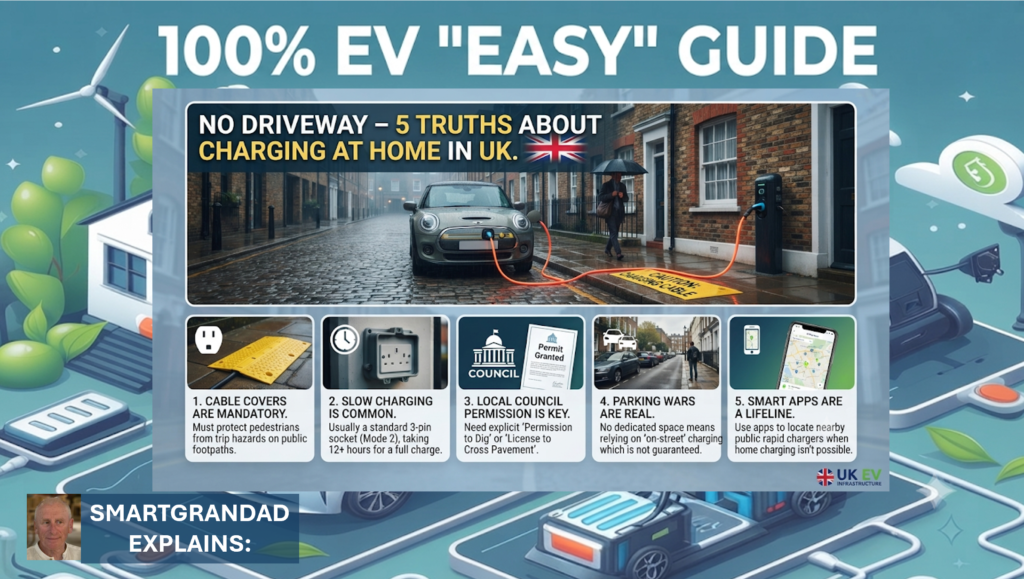
For the nearly 50% of UK drivers who live in terraced houses or apartments, the transition to electric mobility has long felt less like progress and more like a punishment.
 
For a decade, the “driveway barrier” was the ultimate gatekeeper: if you couldn’t plug in at home, you were locked out of the cheapest fuel rates and tethered to the whims of public infrastructure.
 
But as we navigate the landscape of 2026, that barrier isn’t just cracking—it’s being demolished. Through a combination of aggressive legislative “shake-ups,” technical breakthroughs in pavement engineering, and a new neighborhood sharing economy, the urban charging desert is blooming. If you’ve been holding off on an EV because you don’t have a dedicated parking spot, these five truths will change your trajectory.

1. The "Granny Charger" is a Safety Trap, Not a Solution

In the early days of the transition, the 3-pin “granny charger” was marketed as a viable backup. Today, infrastructure specialists are clear: relying on a standard domestic socket for daily charging is a technical gamble you shouldn’t take.
 
The physics are simple but punishing. Standard household appliances like kettles or toasters are “short burst” devices.
 
An EV, however, represents a “sustained draw,” pulling maximum power for 12 to 24 hours straight. Phill Brookes-Maddicks, a technical lead at Indra, warns that standard sockets aren’t designed for this:
 
“Unlike kettles… an EV requires ongoing and sustained maximum power for hours at a time, which is not what most sockets are designed to withstand. This can cause overheating and, in extreme cases, fire risk.”
 
For residents in older properties—specifically those built before 2008—the risks are magnified. Most lack the updated Residual Current Device (RCD) protection required to handle such loads safely.
 
Under Section 722 of the IET Wiring Regulations, dedicated EV circuits now require sophisticated O-PEN fault protection to prevent electric shocks during grid faults—something a standard 3-pin plug simply cannot provide.

⚡ 2. The "Airbnb of Charging" - Could Pay Your Car Loan

We are seeing a radical shift in how we view private assets.
 
Through the partnership between Octopus EV and Co Charger, the home charger is evolving into a neighborhood utility.
 
Data reveals that the average home-charger owner only uses their unit 5% of the time. The other 95% is wasted capacity. By listing these chargers on a community app, owners are earning between £200 and £1,000 per year, effectively subsidizing their own car leases while providing a lifeline to neighbors without driveways.
 
With most UK residents now living within a mile of a “host,” this model creates a bookable, reliable, and affordable “home” charging experience for the urban cliff-dweller.

3. Pavement Channels: The New "Permitted Development" Golden Ticket

2026 has brought the most significant legislative victory for terraced homeowners in a generation.
 
Previously, running a cable across a public pavement was a legal quagmire of liability and planning refusals. That ended with the full implementation of the Planning and Infrastructure Act (2025).
 
The market has also consolidated to meet this demand. In September 2025, industry leader Kerbo Charge acquired Charge Gully, streamlining the rollout of “automatic approval” charging channels.
 
These discreet, professional-grade gullies are now treated under Permitted Development Rights, meaning you can install a safe, trip-free cable solution without the agony of a full planning application.
 
As The Guardian reported during the regulatory shift:
“The government has promised to pass legislation… that will allow motorists to run power cables through a charging ‘gully’ built into the pavement outside their home without the need for planning permission… making every EV on the road a tool for national energy security.”
 
To sweeten the deal, the OZEV grant remains active through 2027. You can claim 75% off the cost, up to £500, for the socket installation, provided it’s paired with a permanent cross-pavement solution. Note the fine print: you must own or be responsible for an eligible vehicle, and the grant cannot be backdated—you must apply before the drill hits the brickwork.

🚘 Vehicles and Global Adoption

  • 4. The “Hidden Lamppost” Revolution and Local Demand
    For the “least invasive” urban solution, look up. Companies like ubitricity (a Shell subsidiary) have converted thousands of existing lampposts into 5.5kW charging points—three times faster than a 3-pin plug and capable of adding 20 miles of range per hour while you sleep.
    However, councils no longer play a guessing game with where to install them. They are utilizing the LEVI (Local Electric Vehicle Infrastructure) Fund—a £381 million war chest—to target streets with high demonstrated demand. Before a lamppost is approved, it must pass a rigorous technical gauntlet:
    • Power Supply: Verification of spare electrical capacity to prevent local grid brownouts.
    • Internal Wiring: Assessment of the column’s ability to house additional fuses and electronics.
    • Physical Dimensions: Ensuring the post is large enough to integrate the charging hardware.
    • Pavement Position: Checking that the post’s location doesn’t create an obstruction for pedestrians or wheelchairs.
    • Parking Conditions: Proximity checks to ensure the post isn’t too close to junctions or double-yellow lines.
    The takeaway? If your street is a “charging desert,” the most impactful thing you can do is organize your neighbors and bombard your council’s “register interest” portal.

🚘 Vehicles and Global Adoption

5. The 15% VAT Penalty: A Social Equity Crisis
Despite the technical wins, a glaring economic injustice persists in 2026: the “tax on the driveway-less.”
If you charge at home, you pay 5% VAT on your electricity. If you are forced to use a public charger because you lack a driveway, you pay 20% VAT. This creates a two-tier society where those with the least space pay the most for their fuel. The industry trade body ChargeUK has been relentless in its pressure on the Treasury to equalize these rates, stating:
“Action on high energy costs is needed to keep the EV transition on track… equalising VAT would help ensure that motorists who cannot charge at home… would not be unfairly penalised.”
As the UK moves toward the 2035 phase-out of new petrol and diesel cars, this 15% gap is no longer just a fiscal quirk—it is a social equity crisis that remains the final “truth” the government must reconcile.

🚘 Vehicles and Global Adoption

Conclusion: The Road to 2035
The UK is no longer a patchwork of isolated charging points. We are witnessing the birth of an integrated urban network where lampposts, community hubs, and pavement gullies work in concert. The “driveway barrier” isn’t just dying; it’s being designed out of existence. The question is no longer can you charge without a driveway, but which of these five solutions you’ll choose first.
So, keep your eyes open for when the next SmartGrandad “Easy 100% EV” Guide  is posted.
0 0 votes
100% EV Model / Article Rating
0 Comments
Oldest
Newest Most Voted