100% EV “EASY” GUIDE 12:
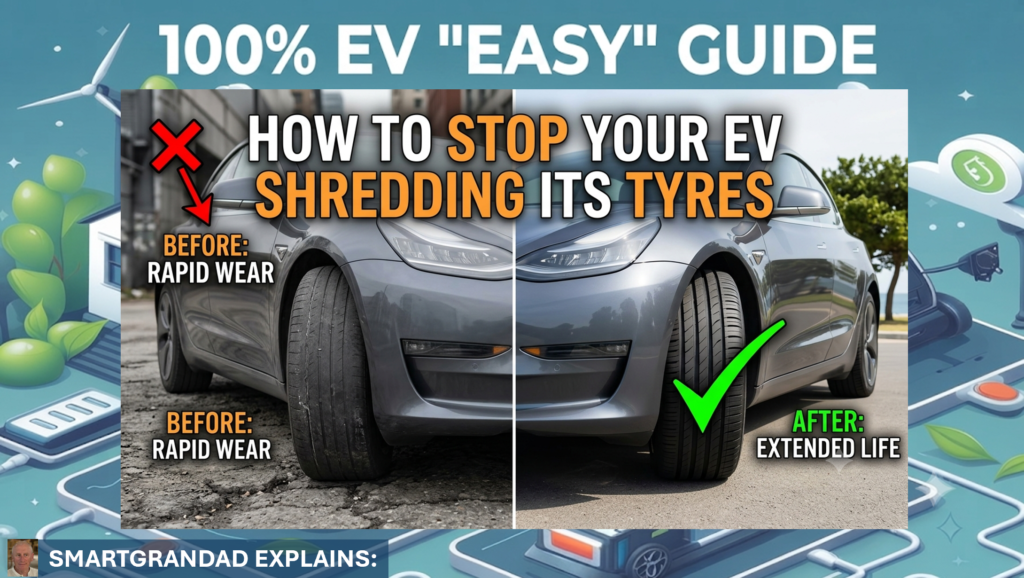
How to Stop Your EV Shredding Its Tyres
Written by SmartGrandad – BEV enthusiast and BEV owner for over 7 years.
SmartGrandads Answers Your FAQs
The transition to electric mobility is often defined by a series of pleasant revelations, but around 15,000 miles /25,000 kilometers there is a costly surprise.
There is the serene quiet of the cabin, the liberation from the gas station, and the near-total elimination of traditional mechanical maintenance.
However, for many new owners, a different kind of surprise arrives around the 15,000-mile mark: a premature trip to the tire shop. Data indicates that EV tires wear out roughly 20% faster than those on internal combustion engine (ICE) vehicles.
While you may never buy a gallon of gasoline again, the high-performance rubber beneath you has become the new primary maintenance cost of the electric age.
So let Smartgrandad Explain why with these 7 “Takeaways”.
Takeaway 1: The "Battery Burden" and the 50% Weight Jump
The most fundamental challenge for an EV tire is vehicle mass. Because of the substantial density of battery packs, electric vehicles are significantly heavier than their gasoline counterparts.
It is a matter of physics: while the battery constitutes “sprung weight”—supported by the vehicle’s suspension—its sheer mass creates massive downward pressure on the “unsprung” components, specifically the tyres.
“EVs typically carry heavy battery packs, which significantly increase the vehicle’s overall weight. For instance, a typical battery electric vehicle can weigh anywhere from 25% to 50% more than a comparable ICE vehicle.”
This “battery burden” forces tires to maintain structural integrity under lateral forces and downward pressure that would cause a standard tire to degrade or deform almost immediately.
Takeaway 2: Instant Torque is a "Silent Tyre Shredder"
The Grip of High Instant Torque Unlike gasoline engines that must build power through a transmission and gear shifts, electric motors deliver 100% of their torque the moment the pedal is depressed.
This “instant torque” is the source of the exhilarating acceleration EVs are known for, but it acts as a silent tyre shredder. Without the gradual build-up of power, the tyres experience significantly greater scrubbing and abrasion against the asphalt.
Every aggressive launch from a standstill effectively uses the road surface to “sand” the tread off the casing.
Takeaway 3: The Counter-Intuitive Stress of Regenerative Braking
While regenerative braking is a hallmark of EV efficiency, it creates a unique stress pattern on your rubber. This system uses the motor as a generator to recover kinetic energy, creating “reverse torque” that applies a backward force to the tyres to slow the vehicle.
This process adds significant stress specifically to the front tires, which traditional cars do not experience to the same degree. If left unmonitored, this lead to irregular wear patterns that can shorten the lifespan of the tyre.
Takeaway 4: The Surprising Emissions Paradox
As exhaust emissions disappear, tyre wear particles have moved into the environmental spotlight. Research suggests a startling paradox: tyre wear emissions attributed specifically to the additional 1,100-pound battery burden of a heavy EV can be 400 times greater than the exhaust particulate emissions from a modern conventional vehicle.
Because the added weight increases the rate of degradation, selecting a durable, high-quality tyre is no longer just a financial choice; it is an environmental imperative to reduce the release of rubber micro-particles.
Takeaway 5: The "4% Range Penalty" You Didn't Know You Were Paying
In the EV ecosystem, efficiency is the ultimate currency. Underinflated tires are a primary drain on this resource, potentially causing a 4% reduction in driving range. This is why “low rolling resistance” (LRR) technology is vital; specialized EV tires use high-tech rubber compounds to minimize energy loss as the tire deforms and rolls.
“Lower rolling resistance means increased electric range and higher efficiency…
For instance, the MICHELIN e·Primacy tire… extends the range by approximately 7%, or around 30 km for a vehicle with a 400 km range.”
Beyond the e·Primacy, performance-oriented options like the MICHELIN Pilot Sport EV can extend a vehicle’s range by up to 37 miles (60 km), proving that the right rubber choice can significantly offset “range anxiety.”
Takeaway 6: Deciphering the Secret "XL" and "HL" Codes
When replacing EV tyres, you cannot simply match the size. You must verify the Load Index. Most EVs require XL (Extra Load) tyres, which feature reinforced structures to carry more weight at higher pressures.
Even more advanced is the HL (High Load) designation. Crucially, an HL tire is engineered to support more weight at the same inflation pressure as an XL tyre, making it the standard for heavy electric SUVs.
Warning: never fit a tyre with a lower load index than the factory specification, as this invites sidewall failure and a total loss of control.
Takeaway 7: Why EV Tyres Wear "Foam Hats"
In the absence of an internal combustion engine, road noise becomes the “main character” of your drive.
To preserve the tranquility of the cabin, premium EV tyres such as “ContiSilent” or “Michelin Acoustic” utilize specialized polyurethane foam liners bonded to the inner tread.
This “acoustic” technology can reduce interior vehicle noise by up to 9 dB(A)—a difference that transforms road hum from a distraction into a distant whisper.
What You Can Do To Reduce Wear?
A Proactive Maintenance Checklist
To maximize your tire investment and maintain peak tyre efficiency, follow this routine:
- Rotation Intervals: Rotate tires every 5,000 to 8,000 km to counteract the irregular wear caused by weight and regenerative braking.
- Monthly Pressure Checks: Monitor inflation monthly. Air contracts in cold weather, which can lead to sudden range loss and increased wear.
- Alignment Precision: Check wheel alignment every 6 months—or immediately after hitting a curb or significant pothole. The high mass of an EV makes it highly susceptible to misalignment.
- TPMS Reset: Always reset your Tire Pressure Monitoring System after a rotation to ensure you receive accurate pressure data for the correct wheel location.
SmartGrandads Final Thoughts
The evolution of the tyre is keeping pace with the electric revolution. We are already looking toward a horizon of “smart tyres” with embedded sensors for real-time wear monitoring and “self-healing” rubber that repairs minor punctures automatically.
As we move toward an emission-free future, we must rethink the very wheels that carry us there. Understanding that your tyres are a high-tech component of your EV’s propulsion system—rather than just a consumable piece of rubber—is the first step toward a more sustainable, silent, and cost-effective drive.
But, the most important aspect, that you can control is “Driving Style”. If you want your tyres to last longer, then follow these 3 guidelines;
1. Minimise those “Flat Out” Startups!
2. Reduce Speed During Sharp Corners
3. Avoid “Last Minute Braking”
By doing these 3 things you will not only reduce the wear/cost of you tyres, but also become a safer driver.
SmartGrandad Would Love To Hear Your Views.
If you have any other ideas or thoughts, please let us know in the comments or via the contact form.
Written by SmartGrandad – BEV enthusiast and BEV owner for over 7 years.
Tagged POSTS