100% EV “EASY” GUIDE 15:
Battery & Vehicle Warranties – Avoid Costly Mistakes
Written by SmartGrandad – BEV enthusiast and BEV owner for over 7 years.
1. The Battery Obsession vs. The Vehicle Reality
For most prospective electric vehicle (EV) buyers, “range anxiety” is closely followed by “battery anxiety.” The fear of a five-figure battery replacement cost a few years into ownership remains a psychological hurdle in the global transition to electric transport.
As SmartGrandad, I can tell you that this fixation is largely outdated. While battery warranties are undeniably essential, they have reached a state of industry-wide standardization that makes them a secondary concern for the savvy buyer.
The real financial trap—and the variable that should dictate your purchase—is the comprehensive vehicle warranty. While most manufacturers offer nearly identical battery protection, the length of warranty for the rest of the car can differ radically. Depending on Brand and Location, you may get from 7 years /150 000km to only 2 years / 80 000km. To protect your investment, you must look past the battery and scrutinize the comprehensive vehicle-specific terms.
2. Battery Warranties
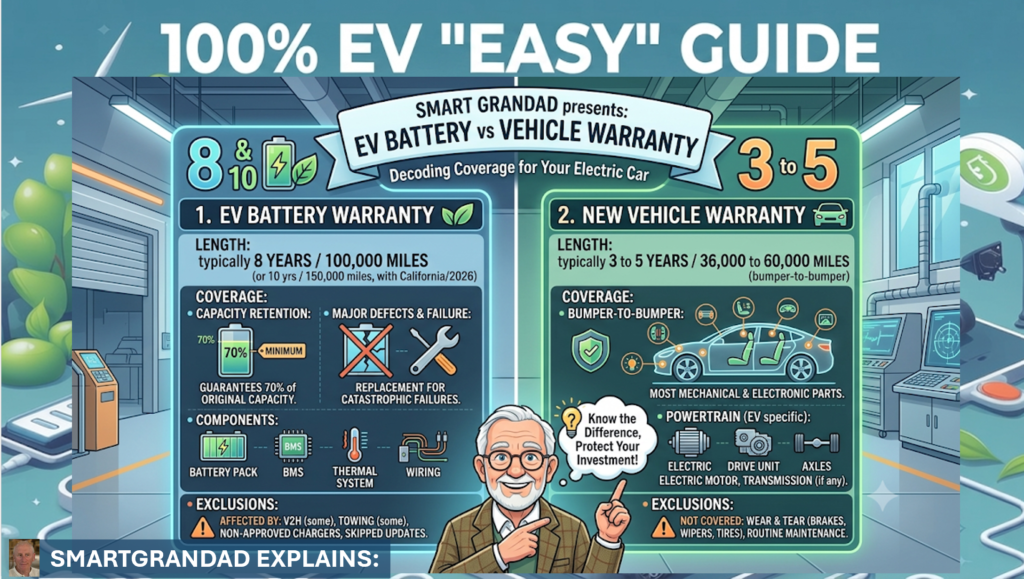
The EV industry has largely coalesced around a baseline for battery health and longevity. Most manufacturers now offer a similar guarantee to provide peace of mind regarding the powertrain’s most expensive component.
A standard battery warranty is currently provided by the following manufacturers:
- Tesla: 8 Years / 160,000 km to 240,000 km (depending on model)
- Volkswagen: 8 Years / 160,000 km
- BMW: 8 Years / 160,000 km
- Hyundai: 8 Years / 160,000 km (extended to 10 years in the US)
- Toyota: 8 Years / 160,000 km
Across these and most other brands, the industry norm for the State of Health (SoH) benchmark is a >= 70% capacity guarantee. This means the manufacturer is only obligated to intervene if the battery’s maximum capacity drops below 70% during the warranty period. Because this protection is so uniform, it no longer serves as a point of competitive differentiation.
3. Vehicle Warranties
4. Comparison: Vehicle Warranty vs. Battery Warranty
While battery terms are standardized, vehicle warranties—covering the infotainment, suspension, climate control, and overall assembly—show massive discrepancies. We are currently seeing a “Great Divide” between brands offering minimal protection and those using long-term warranties as a primary selling point.
The Short-Term Trap Many premium and legacy brands offer surprisingly limited vehicle coverage, creating significant financial risk for owners. Volkswagen, Mercedes-Benz, and Audi often provide as little as 2 to 4 years of vehicle-specific protection. Even more concerning is Ford, which offers a meager 3 years / 60,000 km (37,000 miles) vehicle warranty in the US market. In these cases, a buyer faces high-cost electronic or mechanical repairs while the battery is still covered for another half-decade.
Long-term Coverage Leaders On the other end of the spectrum, several brands are pushing the boundaries of comprehensive protection:
- Kia: 7 years
- BYD: 6 years
- Geely, Hyundai, and Xiaomi: 5 years
The Big Variation: Consider the math. A buyer of a Volkswagen or Mercedes in select markets may receive only 2 years of comprehensive coverage. In contrast, a Kia owner under a specific program receives 7 years. That is a 350% increase in the duration of your protection, representing thousands, in potential savings on non-battery components.
The following table illustrates the “Variation Gap” between comprehensive vehicle protection and battery-specific coverage for key global brands.
Brand | Vehicle Warranty | Battery Warranty |
BYD | 6 Years / 150,000 km | 8 Years / 250,000 km (EU/UK) / 160,000 km (Global) |
Tesla | 4 Years / 80,000 km* | 8 Years / 160,000 – 240,000 km |
Volkswagen | 2 to 4 Years / 100,000 km (varies) | 8 Years / 160,000 km |
Hyundai | 5 Years / Unlimited (EU) / 100,000 km (US) | 8 Years / 160,000 km (10 Years / 160k km in US) |
Kia | 7 Years / 150,000 km (EU) / 5 Years (US) | 7 to 8 Years / 150,000 – 160,000 km (10y Powertrain in US) |
Mercedes-Benz | 2 to 4 Years / 80,000 km (varies) | 8 to 10 Years / 160,000 – 250,000 km |
NIO | 3 to 5 Years / 100,000 – 120,000 km | 10 Years / Unlimited (First Owner) / 8 Years / 160,000 km |
*Note: Tesla vehicle warranty can reach 5 years/unlimited in select markets.
5. Why the Vehicle Warranty Might Be More Important
As an advocate for the consumer, you must understand that todays vehicles are complex computers on wheels, not just a battery. A longer vehicle warranty is a superior value proposition because it hedges against the most likely failure points.
- Powertrain and Drive Unit Vulnerability: While the battery is durable, the motors and drive assemblies are mechanical components subject to wear. BYD offers an 8-year drive unit warranty, and Li Auto provides 8 years / 160,000 km specifically on the drive motor assembly. Without these specific terms, your motor is only as good as your vehicle warranty.
- The “Electronics” Exposure: Modern EVs rely on Advanced Driver Assistance Systems (ADAS), including lidar, radar, and a suite of high-resolution sensors. A failure in a single lidar sensor outside of warranty can cost more than many traditional engine repairs. Brands with 2-year warranties leave you entirely unhedged against these high-tech failures.
- Mechanical and Assembly Issues: HVAC systems, air suspensions, and specialized door handles are common failure points. If your vehicle warranty expires after 2 or 3 years, you are exposed to significant financial risk for the vast majority of your ownership period.
6. Market-Specific Anomalies and "Hidden" Perks
Beyond the standard terms, several manufacturers offer unique programs that can drastically alter the risk profile of your purchase:
- NIO’s Battery-as-a-Service (BaaS): By utilizing a battery swap model, NIO effectively eliminates the risk of battery degradation for the owner. You don’t “own” the battery, so you never own the risk of its failure.
- The “First Owner” Trap: Brands like Geely, SAIC-GM-Wuling, Leapmotor, and XPeng offer “Lifetime” battery or powertrain warranties. However, consumers must be warned: these are almost exclusively for the first owner and are often restricted to the Chinese domestic market. They do nothing for resale value.
- Toyota’s 1 Million Km Guarantee: While the standard coverage is 8 years, Toyota’s EV Care program can extend battery capacity coverage up to 10 years or 1 million km, provided the vehicle undergoes an annual check. This is currently the gold standard for high-mileage users.
7. SmartGrandads Warranty Checklist
To ensure you aren’t left with an unprotected asset, use this checklist before you buy:
- Check the Vehicle-to-Battery Gap: Do not assume a long battery warranty translates to a long vehicle warranty. If the battery is covered for 8 years but the car is only covered for 3, you have a 5-year window of high financial exposure.
- Verify Regional Disparities: Manufacturers vary terms significantly by geography. For example, Hyundai offers 5 years/unlimited km in the EU, but provides a superior 10 years / 160,000 km powertrain and battery term for the original owner in the US. Always check the specific terms for your country.
- Read the “First Owner” Fine Print: Be wary of “Lifetime” promises. If they don’t transfer to the second owner, the car’s resale value will plummet the moment you try to trade it in. Make sure that the regular service requirements have been carried out.
8. SmartGrandads Final Thoughts
Avoid Costly Mistakes when choosing the Brand.
The “Battery Warranty” has become the industry’s commodity—a baseline that almost every manufacturer meets. The “Vehicle Warranty” is the final frontier of competition and the true measure of a brand’s confidence in its product.
Because vehicle-specific protection ranges from a mere 2 years to a robust 8 years, it is currently the most critical factor in determining the long-term cost of EV ownership. When shopping, look past the battery; the rest of the car is where the real risk lies.
SmartGrandad Would Love To Hear Your Views.
Written by SmartGrandad – BEV enthusiast and BEV owner for over 7 years.