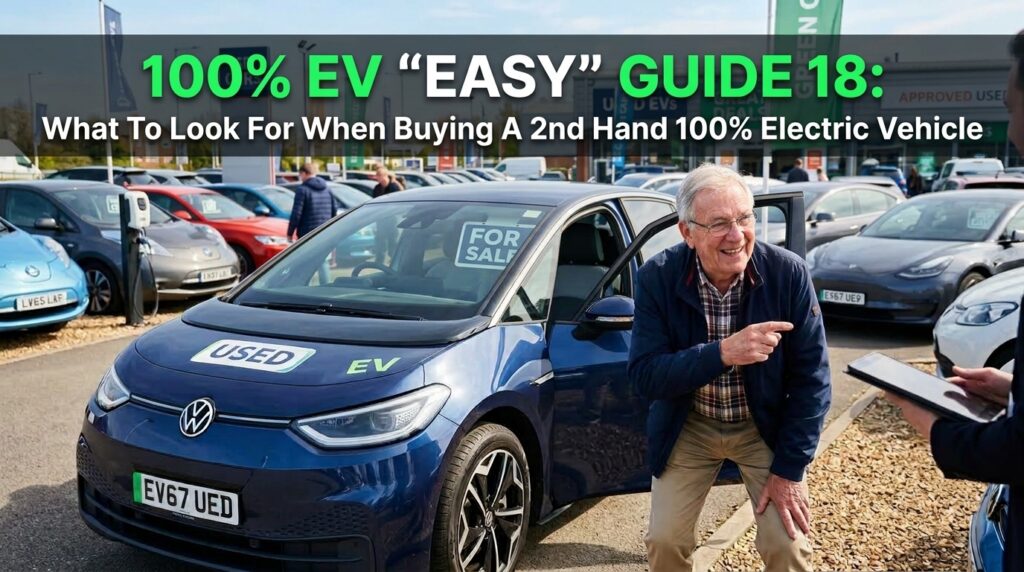
100% EV “EASY” GUIDE 18:
What To Look For When Buying A 2nd Hand 100% Electric Vehicle
NEW
Written by SmartGrandad – BEV enthusiast and BEV owner for over 7 years.
Used 100% EVs Are a Bargain
If you’ve been keeping an eye on the second-hand electric vehicle (EV) market recently, you’ve probably noticed a massive shift: prices have hit an absolute sweet spot. Models that cost a small fortune brand-new just a few years ago are now sitting on dealer forecourts at remarkably sensible prices.
This is the easiest ticket into zero-emission driving. However, thousands of buyers are missing out on the best deals because they’re trapped in an old mindset: treating a second-hand electric car like an old petrol or diesel car.
After decades of car ownership—and years of testing 100% Battery Electric Vehicles (BEVs)—I can promise you that the traditional rules of thumb simply don’t apply anymore.
Today, Battery Health Means Everything.
Factor | Fossil Fuel Mindset | 100% EV Reality |
Primary Wear Point | Engine internals, transmission, exhaust | Battery cell capacity retention (SOH) |
High Mileage Impact | High risk of costly mechanical failure | Minimal impact if battery was kept conditioned |
Key Inspection Item | Oil service records & belt checks | Verified Battery State of Health (SOH) report |
Warranty Focus | Powertrain / Engine block | Factory 8-Year / 160,000 km (100k mi) Battery Warranty |
What to look for when buying a 2nd hand BEV
If you’re shopping for a used 100% electric car right now, and you are not sure what to ask the salesperson about, here are 4 simple steps to getting a proper view of the state of a BEV.
With this information, you will be much better placed to deal with the salesperson and ensure you pay a realistic price.
Step 1: Demand a Certified State of Health (SOH) Diagnostic Report
Do not rely on the dashboard range estimator—often called the “guess-o-meter” because its display fluctuates wildly based on recent driving style, air conditioning use, and outside temperature. Instead, demand an independent or certified On-Board Diagnostics (OBD) battery health report.
So what is SOH (State Of Health)?
State of Health is expressed as a percentage comparing the battery’s current usable energy capacity against its factory-new capacity.
Current Usable Capacity (kWh)
——————————————- x 100 = State of Health%
Original Factory Capacity (kWh)
What Does an SOH Report Look Like?
A third-party test report (such as an AVILOO or dealer-certified OBD readout) gives you a clear snapshot of the battery’s real degradation:
Example of a SOH Diagnostic Summary:
Vehicle Tested: 2021 Model (80,000 km / 50,000 miles on odometer)
- Original Battery Size (Usable): 64 kWh
- Measured Usable Capacity: 59.5 kWh
- State of Health (SOH): 93% (minimal degradation of ~1.8% per year)
- Cell Voltage Delta / Imbalance: 0.012V (Pass: All cells aging uniformly)
SOH Verdict: EXCELLENT — Battery retains 93% of original factory range.
A well-driven car with 80,000 km and a 93% SOH is a far superior buy to a low-mileage car that sat at 0% or 100% charge in a freezing garage for six months, which can cause premature cell stress.
Step 2: Get Confirmation of the Remaining Original Battery & Vehicle Warranties
Battery Warranties; Automakers know EV batteries are durable, which is why almost every manufacturer covers the high-voltage battery pack with a dedicated factory warranty separate from the main car warranty.
- Industry Standard: Most brands guarantee the battery for 8 years or 160,000 km (100,000 miles), promising it won’t drop below 70% SOH during that period.
- The Smart Buyer Advantage: Buying a 3- or 4-year-old EV with high mileage means the initial owner ate the heavy depreciation, yet you still inherit 4 to 5 years of original manufacturer battery protection.
What can be overlooked is the vehicle warranty. Depending on the Make / Model the vehicle warranty may only cover as little as 2 years (100 000km /60 000 miles e.g. Volkswagen), whereas other makes/ models can have up to 7 years (150 000km / 90 000 miles e.g. Kia/ Hyundai) or more!
For more information on Battery and Vehicle Warranties See;
100% EV “EASY” GUIDE 15: Battery & Vehicle Warranties – Avoid Costly Mistakes
Step 3: Verify the Charging Standards and Port Types
To ensure seamless ownership, make sure the car uses standard connectors so you aren’t forced to rely on awkward, expensive adapters or outdated charging networks:
- AC Home Charging (Slow/Fast):
- Ensure the car has a standard Type 2 inlet (or Type 1 if buying an older Japanese import like a gen-1 Leaf). Standard Type 2 lets you plug into any domestic home wallbox or public street charger.
- DC Rapid Charging (Public Highways):
- Look for a CCS (Combined Charging System) plug or NACS (North American Charging Standard) depending on your region. Avoid older used EVs that only feature CHAdeMO fast-charging plugs unless you drive exclusively around town, as CHAdeMO is rapidly being phased out on public charging networks.
Step 4: Ensure the Vehicle Has a Full Service History
While EV servicing is simpler than traditional petrol or diesel maintenance (no oil changes or spark plugs!), skipping this step is a huge risk. This is standard due diligence for any vehicle, but with an EV, it is absolutely critical:
- Protect Your Warranty: EV manufacturers require regular inspections (checking brake fluid, high-voltage cooling systems, cabin filters, and software updates). If the previous owner skipped scheduled services, the manufacturer may void that valuable 8-year high-voltage battery warranty.
- Protect Resale Value: A missing service book or unverified digital record instantly makes the car worth significantly less on the secondary market and raises red flags for future buyers. Always inspect stamped service books or digital dealer service logs before signing anything!
SmartGrandads Final Thoughts - The Bottom Line
Don’t walk away from a great deal on a 100% electric vehicle. A well-cared-for electric car is often the bargain of the decade—provided you know what to look for.
Use Smartgrandads 4 Step checks to verify the battery health and service history upfront and enjoy a modern, cheaper, cleaner driving future.
Step 1: Demand a Certified State of Health (SOH) Diagnostic Report
Step 2: Get Confirmation of the Remaining Original Battery & Vehicle Warranties
Step 3: Verify the Charging Standards and Port Types
Step 4: Ensure the Vehicle Has a Full Service History
See all Smartgrandads 100% EV Easy Guides for No hassle, no stress—just 100% electric driving!
SmartGrandad Would Love To Hear Your Views.
Written by SmartGrandad – BEV enthusiast and BEV owner for over 7 years.