OPINION:
The Great EV Depreciation Myth: Are Used Electric Cars the Ultimate Bargain?NEW
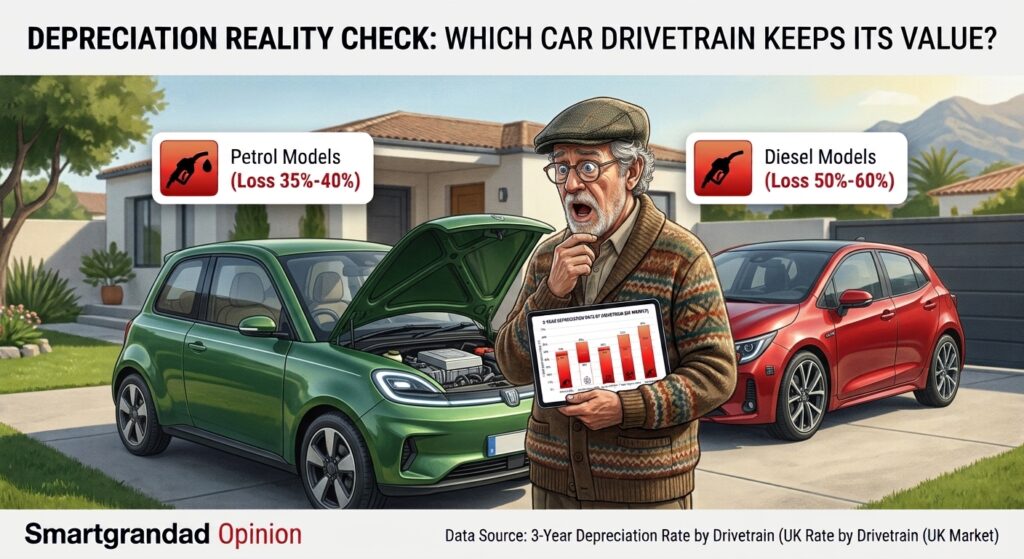
Written by SmartGrandad – BEV enthusiast and BEV owner for over 7 years.
UK Car Depreciation Market Guide 2026
Lets face it Car depreciation represents a major ownership expense as vehicles experience their steepest loss in value during the first year before gradually levelling off over time.
Whenever I chat with friends, meet fellow drivers at charging stations, or read through your emails here at SmartGrandad, one subject comes up more than almost anything else: car depreciation.
It usually starts with a question like: “Aren’t electric cars a terrible financial gamble? Don’t they lose their value faster than an ice cube in the summer sun?”
It is a completely fair question. Over the last couple of years, headlines have been full of dramatic claims about electric vehicle (EV) prices tumbling. If you only read the broadsheets, you would easily assume that buying an EV means watching your hard-earned cash vanish overnight. But as those of you who follow my SmartGrandad guides know, I like to look past the media sensationalism and examine the actual real-world numbers.
When you pull back the bonnet on current UK market data, a much clearer—and far more encouraging—picture emerges. Let’s dig into what the figures really mean, clear up the myths, and see why the secondhand EV market is rapidly turning into one of the smartest places to put your money.
Sources:
- Auto Trader: Written evidence from Auto Trader (ELV0094) (UK Parliament Committees)
- cap hpi: Car future editorial
- Car Insurance Expert: Car Depreciation UK 2026: 40-50% Left After Three Years
- CarCostCheck: Cars That Hold Their Value UK 2026 (Up to 78% After 3 Years)
- Carsa: What is Car Depreciation? Your Complete 2026 Guide
- GAP Insurance 123: Understanding Car Depreciation: Your Ultimate Guide
- Motorway: Car Depreciation – UK Market Guide (2026 Update)
- The AA: Car depreciation – how quickly do new cars lose value?
- Vehiclepedia: How Much Do Cars Depreciate per Year? UK Data
- Warrantywise: Do EVs depreciate faster than petrol and diesel cars?
Cars and 3-Year Depreciation is Complex issue.
1. Fuel Type / Drivetrain
2. Vehicle Type /Size
3. Model-by-Model Divergence Across Key Manufacturers
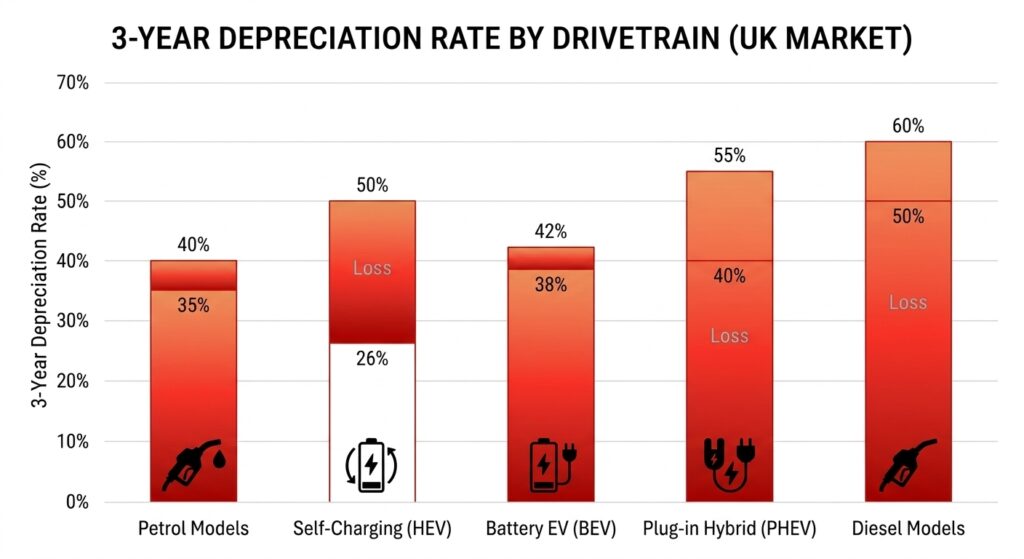
1. Analysis by Fuel Type / Drivetrain (3-Year Depreciation)
Petrol Vehicles
- 3-Year Depreciation Rate: 35%–40% loss of original value after three years.
- Market Dynamics: Petrol models maintain the most stable depreciation profile among internal combustion vehicles. Cars under 12 months old shed an average of 38% against original list price. Lower entry prices and ULEZ compliance insulate small petrol hatchbacks from steep drops. The average used retail price for petrol models sits at £14,988.
Diesel Vehicles
- 3-Year Depreciation Rate: 50%–60% loss of value after three years.
- Market Dynamics: High-specification diesel variants face above-average depreciation due to expanding Clean Air Zones, VED tax brackets, and shifting buyer sentiment. Equivalent diesel models in executive and large SUV segments lose £2,000 to £3,000 more in value than petrol equivalents. Month-on-month trade values experienced a 1.1% decline in recent benchmarks. The average used retail price stands at £14,597.
Plug-In Hybrid (PHEV) & Self-Charging Hybrid (HEV)
- 3-Year Depreciation Rate:
- Self-Charging Hybrids (HEV): 26%–50% loss of value (retaining 50%–74%).
- Plug-In Hybrids (PHEV): 40%–55% loss of value, showing broader variation based on electric range and tax rules.
- Market Dynamics: Self-charging hybrids are among the strongest overall residual performers due to low running costs and zero reliance on public plug-in infrastructure. Monthly trade values grew by +0.3% in recent trade indices.
100% Battery Electric Vehicles (BEV)
- 3-Year Depreciation Rate: 38%–42% loss of value over a standard 3-year ownership period.
- Market Dynamics: While under-12-month EVs showed an initial price drop of 51% against original list price due to heavy new model discounting, 3-year EV depreciation has now stabilized and closely mirrors petrol figures. Following a heavy historical market correction of over 60% between 2022 and 2024, month-on-month trade values slipped by only 0.2%. Used EV sales grew by 57%–59%, with 3-to-5-year-old EVs averaging 25 days to sell on forecourts. Real-world used battery health testing shows 95.15% retained capacity. The average used EV retail price sits at £23,555.
2. Analysis by Vehicle Category (TYPE /SIZE) (3-Year Depreciation)
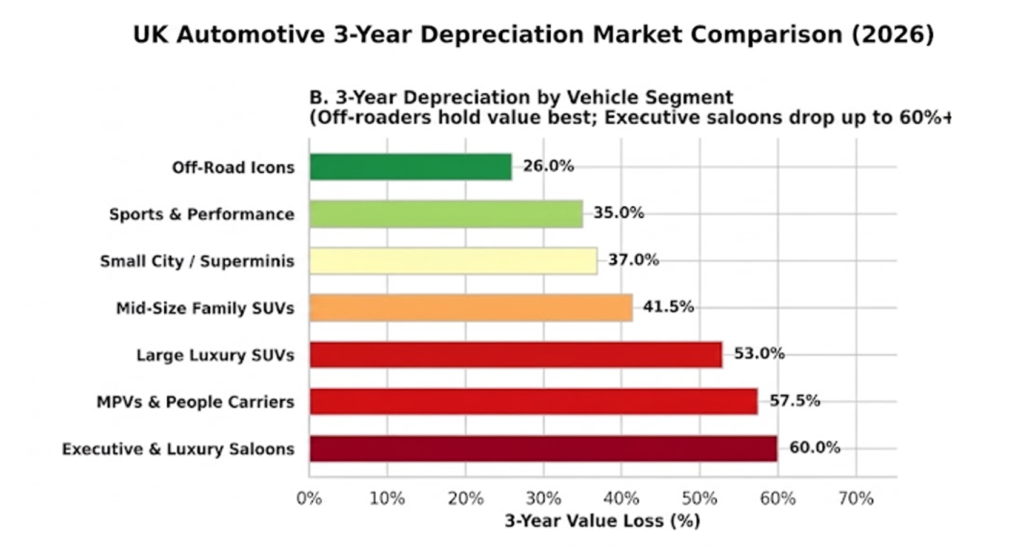
The depreciation of cars is not uniform which a vast range of vehicle types. So, in addition to the Fuel / Drive Train, the type & size of the vehicle has a great impact on its 3 year depreciation.
Lets take a look;
Small City Cars, Superminis & Compact Hatchbacks
- 3-Year Depreciation Rate: 28%–45%.
- Examples: Suzuki Jimny (~28%), Mini Cooper (~37%), Toyota Yaris (~44%), Dacia Sandero (~45%).
- Drivers: Low purchase prices, economical running costs, and steady used buyer demand minimize total financial loss. Discontinued models like the Ford Fiesta are seeing used prices supported as supply tightens.
SUVs & Off-Roaders
- 3-Year Depreciation Rate:
- Off-Road Icons: 24%–28% (Land Rover Defender ~24%, Toyota Land Cruiser ~26%, Mercedes G-Class ~27%, Suzuki Jimny ~28%).
- Mid-Size Family SUVs: 38%–45% (Nissan Qashqai, Kia Sportage, VW Tiguan, Toyota RAV4).
- Large Luxury SUVs: 46%–60% (Range Rover Sport loses 46% between year 1 and 3).
- Drivers: Off-road icons benefit from tight supply and long waiting lists. Mid-size family SUVs remain supported by consistent retail demand, whereas high list prices and large ex-fleet volumes increase depreciation on large luxury SUVs.
Executive & Large Luxury Saloons
- 3-Year Depreciation Rate: 50%–70%+ (BMW 5/7 Series, Mercedes E/S-Class, Audi A6/A8).
- Drivers: Fastest-depreciating vehicle category across all fuel types. High initial list prices, heavy corporate fleet supply flooding the used market, and a small secondary private buyer pool cause rapid value loss.
Sports, Performance & Enthusiast Cars
- 3-Year Depreciation Rate: 22%–43%.
- Examples: Porsche 911 (~22%), Toyota GR86 (~33%), BMW M3 (~34%), Porsche Boxster (~35%), Honda Civic Type R (~38%), VW Golf GTI (~40%), Ford Mustang V8 (~42%), Mazda MX-5 (~43%).
- Drivers: Constrained production, manual gearboxes, iconic design, and strong enthusiast demand insulate performance models from standard mass-market depreciation.
MPVs & People Carriers
- 3-Year Depreciation Rate: 50%–65% (Ford Galaxy, Citroën Grand C4 Spacetourer).
- Drivers: Consumer demand has shifted decisively away from MPVs toward crossovers and SUVs, causing heavy price drops on used forecourts.
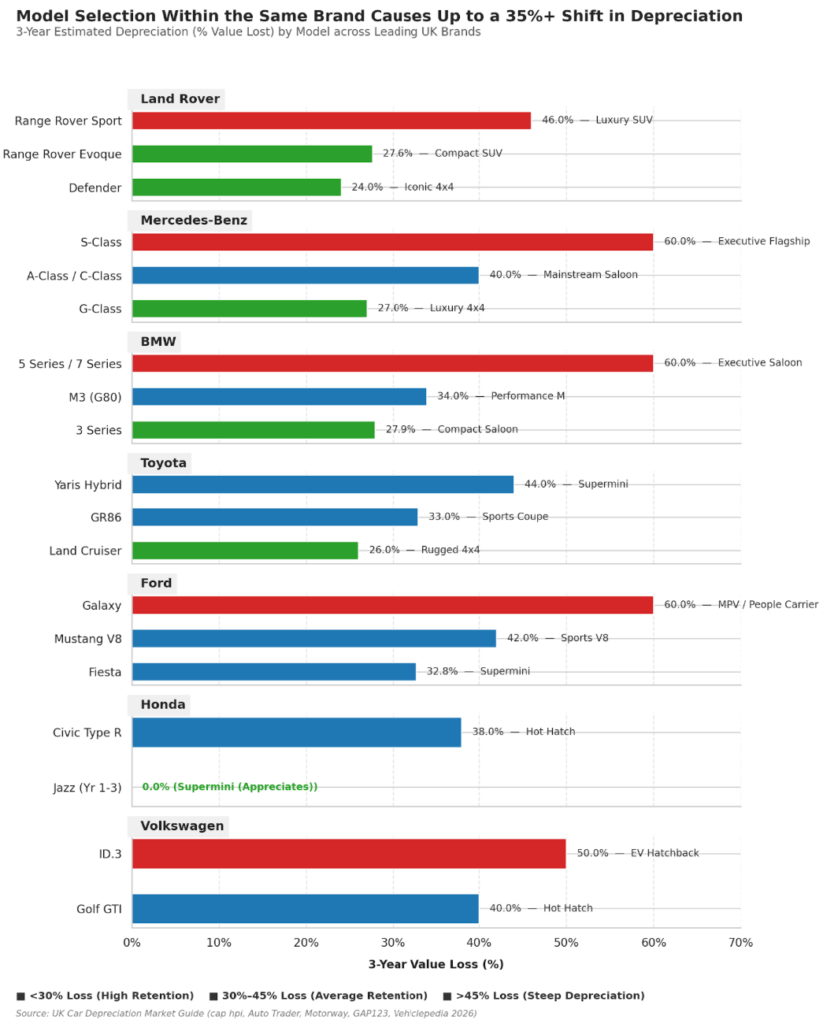
3. Analysis of Model-by-Model Divergence Across Key Manufacturers(3-Year Depreciation)
Key Drivers Behind Model-Level Divergence
Body Style & Segment:
Large executive saloons suffer the fastest depreciation across all brands, whereas compact 4x4s, superminis, and mid-size family SUVs hold value best.
Fleet Volume vs. Retail Demand:
Models sold in massive volumes to corporate company fleets (e.g., 5 Series, E-Class, A6) hit the used market simultaneously at 36 months, driving prices down.
Enthusiast & Niche Status:
Performance trims (BMW M3, Golf GTI, Civic Type R, Audi RS3) retain value far better than standard fleet variants of the exact same vehicle.
Powertrain & Trim:
Large diesel variants and early-generation short-range EVs lose value faster than petrol or self-charging hybrid versions of the same model line
Examples of Just How Much The Divergence Can Be
Land Rover
- Defender: Depreciates just ~24% over 3 years (~76% value retained), supported by 12-month new-car waiting lists and tight used supply.
- Range Rover Evoque: Loses 27.6% between Year 1 and Year 3.
- Range Rover Sport: Drops 46% between Year 1 and Year 3 (and 55% over 5 years) due to high initial list prices and large ex-fleet volume supply.
BMW
- BMW M3 (G80): Depreciates ~34% over 3 years (~66% retained), insulated by strong enthusiast demand.
- BMW 3 Series: Drops 27.9% between Year 1 and Year 3.
- BMW 5 Series & 7 Series: Suffer heavy 50% to 70%+ depreciation over 3 to 4 years as corporate fleet supply floods the secondhand market.
Mercedes-Benz
- G-Class: Depreciates ~27% over 3 years (~73% retained) as an iconic status symbol with constrained production.
- A-Class & C-Class: Hold value reasonably well among mainstream luxury hatchbacks and saloons (~35%–45% loss).
- S-Class & E-Class: Lose 50% to 70%+ of list price over 3 to 4 years due to a smaller secondary buyer pool and heavy fleet turnover.
Toyota
- Land Cruiser: Depreciates ~26% over 3 years (~74% retained) due to legendary reliability and limited allocation.
- GR86 Sports Coupe: Depreciates ~33% (~67% retained) due to manual gearbox sports car scarcity.
- Yaris Hybrid: Depreciates ~44% (~56% retained) as a popular supermini.
- Hilux Pick-up: Loses 54% over 5 years.
Honda
- Civic Type R: Depreciates ~38% over 3 years (~62% retained) supported by perennial waiting lists.
- Honda Jazz: Demonstrates unique value resistance, actually gaining +3% in value between Year 1 and Year 3 in lease market benchmark data.
Ford
- Mustang 5.0 V8: Depreciates ~42% over 3 years (~58% retained) due to a dedicated V8 enthusiast community.
- Fiesta: Lost 32.8% from Year 1 to Year 3; supply tightening post-discontinuation is helping support secondhand values.
- Galaxy MPV: Depreciates rapidly as consumer demand shifts away from people carriers toward family SUVs.
SmartGrandad’s Take: Answering the Big Questions
So, where does this leave you as practical, sensible buyer looking to make the right choice for your driveways and bank balances?
1. Is EV depreciation really worse than fossil fuel cars?
In the early days of modern EVs, fast tech advances and initial price corrections meant early adopters took a big hit. But today, the data tells a completely different story.
At 38% to 42% value loss over 3 years, a 100% Battery Electric Vehicle retains its value almost identically to a petrol car and performs significantly better than a diesel.
Furthermore, used EV demand is booming—sales grew by almost 60% year-on-year, with 3-to-5-year-old EVs selling in an average of just 25 days on dealer forecourts. And if you’re worried about battery degradation, real-world health testing shows that 3-year-old EV batteries retain an average of 95.15% of their original capacity. The batteries are simply lasting far better than the sceptics predicted.
2. Will EV depreciation continue to improve in the future?
Yes, I believe it will. As manufacturing scale increases and battery production costs fall, new EV purchase prices are becoming more competitive. If 3-year residual values remain steady while new buying prices come down, total monetary depreciation drops.
Conversely, as volumes for fossil-fuel cars shrink, manufacturing costs per unit could rise, meaning fossil-fuel vehicles may face higher depreciation in the coming years.
3. Is the old belief that “EVs cost too much” broken?
In my opinion, YES—that old belief is well and truly BROKEN and I don,t think that its ever likely to come back.
When you combine lower entry prices on the secondhand market, stabilized depreciation, significantly lower servicing and maintenance requirements, and the huge savings from charging at home on an off-peak tariff, a 3-to-4-year-old EV is now one of the most cost-effective, hassle-free secondhand cars you can buy.
Is It A Good Time To Consider A 3 Year Old EV?
In my opinion, YES, Uk. secondhand prices are probably as low as they will get. But make sure you choose wisely and check the remaining vehicle warranty and the service history.
Whats your view?
Are you thinking about picking up a secondhand EV, or are you still sitting on the fence about battery life and depreciation? I’d love to hear your thoughts and experiences—leave a comment below or send me a message!
Written by SmartGrandad – BEV enthusiast and BEV owner for over 7 years.
SG UPDATES / CORRECTIONS
Although I try hard to have accurate and up to date information, please let me of any corrections / improvements that are required, using the SmartGrandad Contact Form below. (include the post URL).
Thankyou Smartgrandad