100% EV “EASY” GUIDE 21:
Next-Gen Electric Cars
BYD’s Blade 2 Battery & 2027 EV LineupNEW
Prefer a Short Video?
Written by SmartGrandad – BEV enthusiast and BEV owner for over 7 years.
2027 Significant Move Forward In EV Battery Technology
For parents planning family road trips, driving children to weekend activities, or searching for a safe, reliable, and future-proof vehicle, electric vehicles (EVs) have transitioned from a novelty to a highly practical choice. At the heart of any great EV is its battery technology.
Following the official release of BYD’s second-generation Blade Battery—commonly known as the Blade Battery 2.0 or Gen 2 Blade Battery—the electric vehicle landscape has experienced a major generational shift. This technological leap addresses every major concern EV buyers historically faced: range anxiety, long fast-charging queues, cold-weather battery drain, and long-term battery degradation.
Heading into 2027, BYD is rolling out this revolutionary power pack across its global vehicle lineup, alongside an ambitious roadmap for all-solid-state battery technology. Here is a comprehensive guide for SmartGrandad.com readers on how the Blade 2 battery works, its core advantages over previous battery generations, the BYD models adopting it for 2026 and 2027, and what to expect on the horizon.
5 Point Analysis Of The BYD Blade Battery Gen 2
1. What Is the BYD Blade 2.0 Battery?
When BYD introduced the original Blade Battery in 2020, it revolutionized the industry by replacing bulky battery modules with long, thin, blade-shaped cells arranged directly inside the pack. This Cell-to-Pack (CTP) structural arrangement eliminated heavy module housings and enabled the battery pack to double as a structural member of the vehicle chassis.
The second-generation Blade Battery 2.0 builds upon that structural framework while introducing a fundamental material shift. While the first generation relied on standard Lithium Iron Phosphate (LFP) chemistry, technical breakdowns published by battery research institutions like IEST Instrument confirm that Blade 2.0 transitions to a Lithium Manganese Iron Phosphate (LMFP) cathode paired with a Silicon-Carbon composite anode.
The Breakthrough Chemistry Inside
- LMFP Cathode Architecture: By substituting a portion of iron with manganese inside the olivine crystal lattice, BYD raised the operating cell voltage from roughly 3.2V to 3.8V. This voltage increase delivers an immediate 15% to 20% energy density advantage over standard LFP at comparable material cost. To solve historical manganese dissolution issues at elevated temperatures, BYD engineered a core-shell coating where a manganese-rich core is wrapped in an iron-heavy outer shell layer to prevent surface degradation.
- Silicon-Carbon Composite Anode: Moving away from standard graphite, the negative electrode incorporates nanoscale silicon and graphite particles. To handle silicon’s physical volume expansion during charging, BYD utilizes core-shell nanostructures and elastic binder materials, reducing internal resistance by approximately 20% and limiting heat buildup during high-rate charging.
- Molecularly Engineered SEI Layer: A thin, unusually dense Solid Electrolyte Interphase (SEI) film forms on the anode surface. Featuring dynamic self-repairing behavior, this molecular layer maintains its integrity across thousands of cycles, allowing the battery to tolerate high charging voltages without capacity loss.
2. The 5 Major Advantages of the Blade 2 Battery
For drivers evaluating their next vehicle, the technical innovations inside Blade 2.0 translate directly into five practical real-world benefits.
Key Takeaway: Blade 2.0 combines the safety, affordability, and cobalt-free credentials of lithium-iron chemistries with the high energy density and ultra-fast charging capabilities previously reserved for expensive nickel-based batteries.
1. Massive Energy Density & 1,000+ km Driving Range
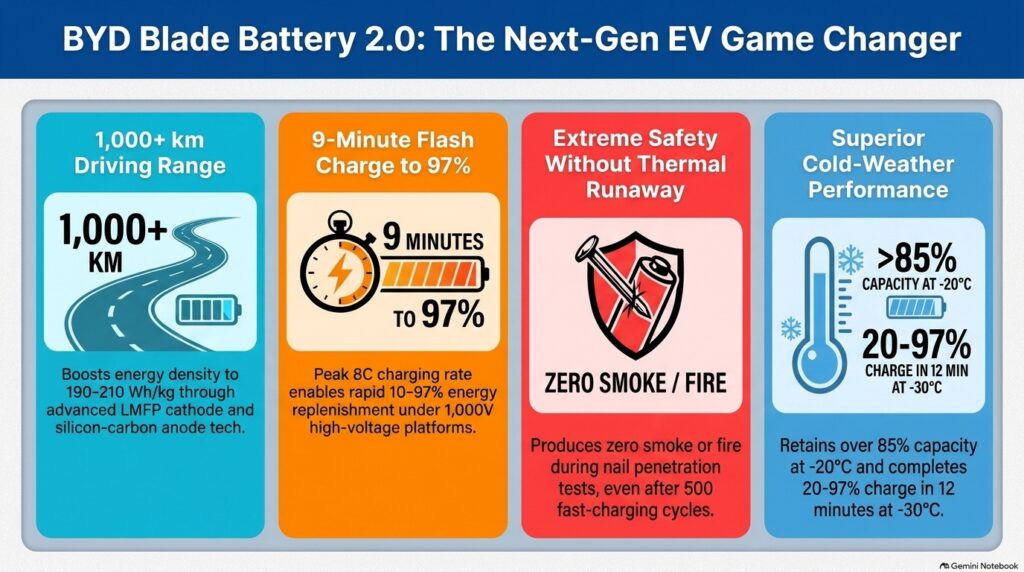
First-generation Blade packs achieved an energy density of roughly 140 Wh/kg. Blade 2.0 elevates cell-level energy density to 190–210 Wh/kg—a density surge of 30% to 40% without increasing physical weight or battery dimensions. Combined with BYD’s Cell-to-Body (CTB 2.0) design—which achieves 76% volumetric space utilization inside the chassis—flagship vehicles powered by Blade 2.0 comfortably break the 1,000-kilometer (CLTC) range barrier on a single charge.
2. “Flash Charging”: 10% to 97% in Just 9 Minutes
To make EV charging as fast as filling a gas tank, BYD designed Blade 2.0 to support 8C peak charging rates and paired it with a full-domain 1,000V high-voltage vehicle architecture called the Super e-Platform. When connected to BYD’s Megawatt Flash Charging stations (delivering up to 1,000V and 1,500A for roughly 1,500 kW of charging power):
- A 10% to 70% charge takes approximately 5 minutes.
- A 10% to 97% charge takes approximately 9 minutes. Even on conventional public DC fast chargers, Blade 2.0 charges 30% to 50% faster than standard EV battery packs.
3. Superior Cold-Weather Resilience
Sub-zero winter temperatures have traditionally caused EV range to plummet and charging speeds to slow significantly. Blade 2.0 addresses this with a direct refrigerant 3D dual-lane cooling and heating system offering 90% higher heat-transfer efficiency. In testing conducted at extreme sub-zero temperatures (-30°C), Blade 2.0 replenished from 20% to 97% state-of-charge in just 12 minutes, while retaining over 85% of its capacity at -20°C.
4. Unrivaled Safety Under Extreme Abuse
Safety remains BYD’s primary engineering commitment. The original Blade Battery earned its reputation by passing the rigorous nail-penetration test without fire or smoke. Blade 2.0 pushes safety testing even further:
- Post-Fast-Charge Nail Test: A steel nail penetrated fully charged Blade 2.0 cells that had already undergone 500 consecutive Flash ultra-fast charging cycles during active charging, resulting in zero smoke, fire, or thermal runaway.
- Simultaneous Short Circuit: Short circuits induced simultaneously across four cells reached internal temperatures above 700°C without causing explosion or open flames.
- 50-Ton Crush Resistance: The honeycomb structural pack withstands a 50-metric-ton mechanical crush force, serving as an ultra-strong underbody shield for the cabin.
5. Outstanding Longevity & Two Physical Formats
BYD rates Blade 2.0 for 3,000 to over 4,000 full charge-discharge cycles, translating to a projected vehicle lifespan of 15 years or between 300,000 and 500,000 kilometers before capacity degrades below 80%. Furthermore, BYD produces Blade 2.0 in two tailored physical formats:
- Short Blade 2.0 (500–580 mm): Optimized for 8C charging and 16C discharge, prioritizing maximum power delivery for performance models.
- Long Blade 2.0 (960 mm): Optimized for 3C charging and maximum energy density (up to 210 Wh/kg), prioritizing long driving range.
3. Generational Comparison: Blade 1.0 vs. Blade 2.0
The following table summarizes the generational leap achieved between the first-generation Blade Battery and the second-generation Blade 2.0 platform.
Specification / Feature | First-Gen Blade Battery (1.0) | Second-Gen Blade Battery (2.0) | Real-World Impact for Drivers |
|---|---|---|---|
Cathode Chemistry | Pure Lithium Iron Phosphate (LFP) | Lithium Manganese Iron Phosphate (LMFP) | Higher operating cell voltage (3.8V vs 3.2V) |
Anode Material | Standard Graphite | Nanoscale Silicon-Carbon Composite | Faster ion transport & 20% lower internal resistance |
Energy Density | ~140 Wh/kg | 190–210 Wh/kg | 30%–40% increase in energy stored per kg |
Flagship Range (CLTC) | ~600 km | Over 1,000 km | Drive long distances without frequent stops |
Peak Charge Rate | 2C–3C | Up to 8C (1,500 kW peak) | Adds hundreds of kilometers in 5–9 minutes |
Standard 10–80% Charge | ~33 minutes | ~9 minutes (10–97% Flash Charge) | Fast recharge times rivaling internal combustion fueling |
Cold Weather (-20°C / -30°C) | Capacity drops below freezing | Retains >85% capacity; 12-min charge at -30°C | Reliable starting and driving in freezing winter climates |
Volumetric Space Utilization | ~50% (Cell-to-Pack) | ~76% (Cell-to-Body 2.0) | Slimmer battery floor creates more cabin legroom |
Cycle Lifespan | ~3,000 cycles | 3,000 to 4,000+ cycles | Built to last 15 years / up to 500,000 km |
4. BYD Models Powered by Blade 2.0 Heading into 2027
To meet surging consumer demand, BYD has expanded cell manufacturing output across its factory complexes (achieving monthly battery installation volumes exceeding 11.8 GWh). BYD plans to equip over 70% of its electric vehicle lineup with Gen 2 technology. Key vehicles featuring Blade 2.0 in 2026 and shaping BYD’s global 2027 showroom include:
Luxury & Flagship Models
- Yangwang U7: BYD’s ultra-luxury flagship electric sedan features a massive 150 kWh Blade 2.0 battery pack delivering a single-charge driving range of 1,006 km (CLTC) alongside 1,000V architecture.
- Denza Z9GT: This high-performance luxury grand tourer packs a 120 kWh Blade 2.0 pack, achieving an impressive 1,036 km CLTC range and full Megawatt Flash Charging compatibility.
- BYD Han EV Flash Charge Edition: Built on BYD’s popular executive sedan chassis, this updated variant features a 69.07 kWh Blade 2.0 pack giving 705 km CLTC range, DiPilot “Eye of the Gods” driver assistance, and 5-minute flash charging.
Executive Sedans & Family SUVs
- BYD Seal 07 (Second Generation): Grown to 5,080 mm in length with a 2,960 mm wheelbase, the second-generation Seal 07 features Blade 2.0, DiSus-M magnetorheological body control, zero-gravity massage seats, Devialet 20-speaker audio, and 9-minute flash charging.
- BYD Seal 08: Positioned as a flagship executive sedan carrying a 250,000 RMB pre-order target, the Seal 08 relies heavily on accelerated Blade 2.0 production lines.
- BYD Han L & Tang L (Sealion 8): Showcasing BYD’s Super e-Platform, these models combine Blade 2.0 with 30,000 rpm electric motors (580 kW) and 1,500V silicon carbide power chips.
- Denza D9 Flash Charge Edition & Denza N8: The luxury 7-seater MPV receives a 115.07 kWh Blade 2.0 pack with 608 km range and 9-minute charging, while the revamped 5-seater N8 SUV offers up to 1,003 km of range.
Mass-Market & Global Export Rollouts
- BYD Sealion 7: Compact and mid-size SUVs equipped with Short Blade 2.0 formats for high power delivery and rapid charging.
- BYD Yuan Plus (Atto 3), Dolphin, and Seagull: As production scales up, BYD’s global lineup—including export models bound for Europe, Australia, and international markets throughout 2026 and 2027—will progressively update from Gen 1 to Gen 2 Blade batteries, giving budget-conscious buyers significantly improved range and charge speed.
Click the Links or go to SmartGrandad.com to find out more about these models.
5. Beyond Blade 2.0: BYD’s 2027 All-Solid-State Battery Roadmap
While Blade 2.0 represents the pinnacle of liquid/gel electrolyte technology, BYD is simultaneously advancing toward the next major battery milestone: all-solid-state batteries.
According to official executive announcements and technical timelines published by industry partners like NEWARE:
- 2024–2025 Pilot Phase: BYD successfully produced pilot 60Ah all-solid-state cells with cell-level energy density reaching 400 Wh/kg (and volumetric density exceeding 800 Wh/L) using a sulfide composite electrolyte and high-nickel ternary cathode.
- 2027 Vehicle Demonstration: BYD plans to launch its first small-batch demonstration fleet (~1,000 units) of high-end electric coupes equipped with all-solid-state batteries in 2027. These demonstration vehicles are targeted to achieve a driving range exceeding 1,200 kilometers on a single charge.
- Commercial Scale by 2030: BYD aims to scale solid-state production lines to reduce costs to ~$70/kWh, achieving price parity with liquid batteries and driving full-scale production after 2030.
6. SmartGrandad’s Summary & Buyer’s Verdict
The arrival of the BYD Blade Battery 2.0 marks a true turning point in electric vehicle practicality. By combining the safety and stability of lithium manganese iron phosphate with smart engineering, BYD has delivered an EV battery that:
Eliminates range anxiety with real-world driving ranges exceeding 1,000 km.
Eliminates charging friction by adding hundreds of kilometers in 5 to 9 minutes.
Ensures family safety with industry-leading mechanical strength and puncture resistance.
Guarantees long-term value through a 15-year, 4,000-cycle design life.
If you are considering an electric car for family travel over the next few years, look for Blade 2.0 specifications in newly arriving 2026 and 2027 BYD models.
Whats your view?
Are you thinking about picking up a secondhand EV, or are you still sitting on the fence about battery life and depreciation? I’d love to hear your thoughts and experiences—leave a comment below or send me a message!
Written by SmartGrandad – BEV enthusiast and BEV owner for over 7 years.
SG UPDATES / CORRECTIONS
Although I try hard to have accurate and up to date information, please let me of any corrections / improvements that are required, using the SmartGrandad Contact Form below. (include the post URL).
Thankyou Smartgrandad
Tagged POSTS