100% EV “EASY” GUIDE 23:
Explaining “Plug & Charge”NEW
Prefer a Short Video?
Written by SmartGrandad – BEV enthusiast and BEV owner for over 7 years.
1. Introduction: The Dream vs. The Reality of EV Public Charging
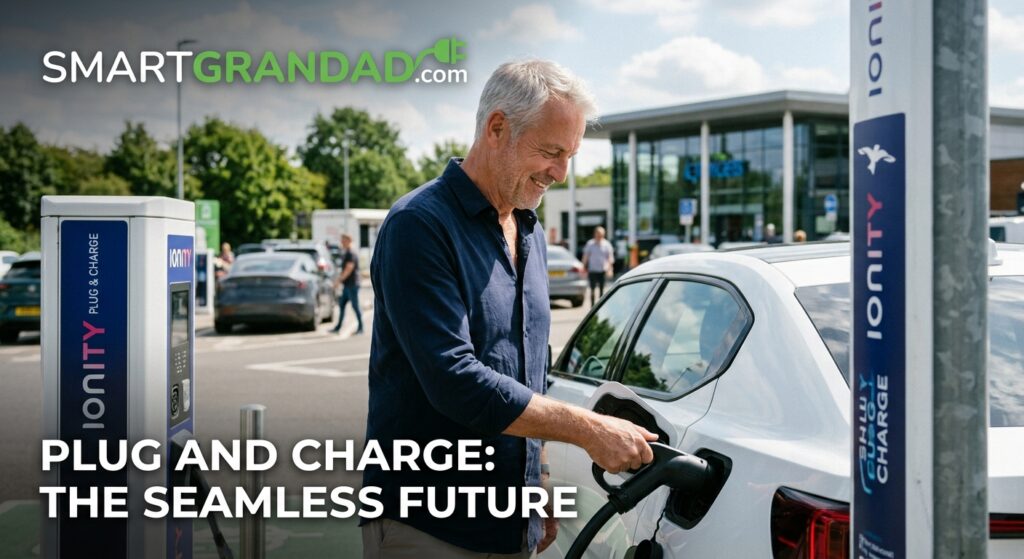
For years, electric vehicle (EV) advocates have outlined a seamless vision for public charging: an owner pulls up to a charging station, plugs in the cable, walks away, and grabs a coffee. However, the daily reality for many EV drivers involves a far more frustrating set of procedures.
To illustrate this contrast, the table below highlights the gap between the promised user experience and the current friction points encountered at public stations:
The Charging Experience: Promised Dream vs. Everyday Reality
The Dream | Everyday Reality |
|---|---|
Effortless Plug & Charge: Roll up, plug in the charging cable, auto-authenticate, and walk away to grab a coffee without touching a screen or payment device. | App Overload: Managing multiple mobile apps and scanning QR codes to initiate a session. |
Invisible Authentication: Automatic background digital communication handles authorization and billing instantly. | Hardware & Touchscreen Failures: Encountering frozen touchscreens at public chargers. |
Zero Setup Friction: No physical cards, fobs, or manual payment registration required at the charger. | Fob Juggling: Juggling up to five different RFID fobs to find one accepted by the specific network. |
Reliable Operation: Seamless start regardless of environmental conditions or cellular connection. | Manual Registration in Harsh Conditions: Frantically typing credit card details into a phone in torrential rain with zero mobile signal. |
While Europe has legally mandated the technology to fix these issues under the Alternative Fuels Infrastructure Regulation (AFIR), turning that law into everyday reality is far more complex than it sounds.
2. What is “Plug & Charge” and What Do You Need to Use It?
From an infrastructure perspective, understanding Plug & Charge requires separating the physical hardware layer from the digital cryptographic layer. “Plug & Charge” is a technical standard—governed primarily by ISO 15118 under the European Union’s Alternative Fuels Infrastructure Regulation (AFIR)—that enables automatic authentication and billing directly through the charging cable. Under AFIR, ISO 15118 serves as the legal baseline for new public chargers popping up across Europe, requiring hardware to carry the underlying digital architecture for effortless authentication.
However, having the physical cable connected is only half the equation; a secure digital connection must also be established. To successfully execute a Plug & Charge session, a complete “Digital Chain of Trust” must be established across three critical links:
- Vehicle Hardware & Manufacturer (OEM): The car manufacturer must install secure digital certificates within the vehicle at the factory using specialized Hardware Security Modules.
- e-Mobility Service Provider (eMSP): The service provider handling the driver’s charging account and billing must issue a matching contract certificate tied to payment.
- Charging Point Operator (CPO): The charging network operator must equip its physical stations with ISO 15118-compliant hardware and software, while actively trusting the exact same root certificate authority as the OEM and eMSP.
Vehicle Compatibility Note
Native Plug & Charge capability is not universally available across all electric vehicles. While newer premium vehicles from manufacturers like BMW, Porsche, Mercedes, and Hyundai/Kia carry the necessary hardware security modules to support ISO 15118 digital certificates, millions of existing electric cars on European roads—including budget-friendly models and earlier generation battery electric vehicles (BEVs)—lack this required hardware and are left out in the cold.
While understanding these individual prerequisites is essential, bringing all three components together seamlessly across vast public networks creates a major systemic bottleneck.
3. The “Mandate Catch”: Why Public Charging is Still a Mess
The core issue behind real-world charging friction lies in a crucial regulatory reality: installing the plumbing isn’t turning on the tap. Under AFIR rules, Charging Point Operators (CPOs) are legally required to install hardware and software that supports ISO 15118 protocols—including ISO 15118-2 and the newer ISO 15118-20 standard, which introduces higher encryption levels and mandatory support for bidirectional charging (Vehicle-to-Grid).
However, regulatory compliance at the station level does not guarantee an active service. Installing ISO 15118-compliant hardware on a charger is like putting a phone jack in a house—it provides the physical plumbing and capability, but it does not mean anyone has activated a operational service contract.
To understand why standard European public chargers lag behind closed charging networks, it helps to compare their underlying operational structures:
Closed Ecosystem vs. Open European Standard
Closed Ecosystem (e.g., Tesla Supercharger Network) | Open European Standard (ISO 15118 Deployment) |
|---|---|
Number of Entities Involved: 2 Parties. Seamless communication occurs directly between two entities: the vehicle and the network operator. | Number of Entities Involved: 7+ Entities. Requires complex coordination across seven or more distinct entities, including carmakers, energy networks, certificate pools, and roaming platforms. |
Failure Resilience: Invisible Background Sync. Communication and authentication are managed entirely within a single closed system, minimizing friction points. | Failure Resilience: Multi-Party Blame-Shifting. When a digital handshake fails, the car blames the charger, the charger blames the backend provider, and the driver is left with a dead cable. |
Because the open European standard relies on an extended multi-party chain, any issue within the digital architecture leads to immediate system fallbacks:
- Consequence of a Broken Link: If a single digital certificate or handshake fails anywhere across the 7-party chain, the automated system stops, and the station immediately falls back to requiring manual payment (such as scanning QR codes or tapping RFID cards).
Understanding these operational hurdles makes it easier to navigate current charging realities while looking ahead to the long-term benefits this technology will eventually deliver.
4. The Smart Driver’s Verdict & Future Outlook
Despite current implementation hurdles, ISO 15118 remains the correct long-term technical standard for the EV ecosystem. Beyond basic billing and automatic authentication, the standard establishes critical technical capabilities for the future of clean transportation:
- Higher Encryption: Advanced specifications under ISO 15118-20 introduce upgraded cryptographic standards for maximum data security during vehicle-to-grid communications.
- Vehicle-to-Grid (V2G) Capabilities: ISO 15118-20 provides the essential secure communication protocols required for bidirectional power flow, enabling EVs to feed energy back into the home or main grid.
- Smart Energy Management: Facilitates automated, real-time control of charging rates and grid balance without user intervention.
The Smart Driver’s Checklist
Because mandating complex digital certificate ecosystems without enforcing seamless cross-network roaming creates temporary friction, EV drivers should maintain backup authentication tools. During this transitional period, drivers should retain their favorite physical charging fobs and active dynamic roaming apps rather than relying exclusively on automatic Plug & Charge functionality.
While ISO 15118 is undeniably the correct technical standard for the future, getting the complex digital ecosystem to behave “boringly” and reliably takes time during this transition period.
Written by SmartGrandad – BEV enthusiast and BEV owner for over 7 years.
Tagged POSTS