TESLA CYBERCAB: PREVIEW Is Tesla’s Cybercab the Ultimate Hands-Off EV?
SmartGrandads Overview
The Tesla Cybercab is Tesla’s purpose-built, two-seater autonomous robotaxi. Engineered completely without pedals or a steering wheel, it relies entirely on Tesla’s full self-driving AI camera network. It features butterfly scissor doors, wireless inductive charging (eliminating traditional plug-in ports), and ultra-efficient aerodynamics.
WLTP / EPA Range: Estimated ~472 km / ~293 miles
Target Price: Under €28,000 / £24,000 / $30,000 target purchase cost
Warranty: Expected standard Tesla coverage (4 yrs/80,000 km vehicle; 8 yrs/160,000 km battery).
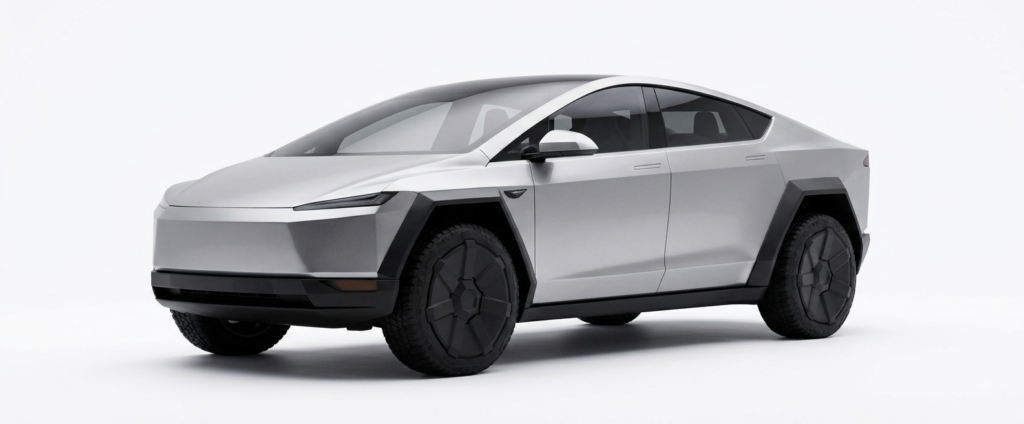
Body Style and Size Segment
The Cybercab features a compact 2-door liftback coupe design with futuristic scissor doors and no rear window. Occupying the subcompact (B-segment) size footprint, its curb weight is approximately 1,412 kg (3,113 lbs) with an overall length around 4.3 meters.
Platform Architecture
Built on Tesla’s unboxed next-gen platform operating at standard nominal ~326V, it uses a 48 kWh lithium-ion battery pack.
Range & Efficiency: ~472 km / 293 miles (~8.9 km/kWh / 5.5 miles/kWh).
Performance: Single rear-motor / FWD drivetrain producing 219 hp (163 kW), achieving 0–100 km/h in roughly 6.8 seconds.
Technical Capabilities
Operates using Hardware 4 / AI4 full self-driving vision suite with roof-integrated Starlink satellite connectivity. Charging is purely wireless/inductive. It does not support traditional V2L, V2H, or V2G hardware outputs.
Quality & Warranty
Features durable, minimalist synthetic interior fabrics and unpainted, impact-resistant polyurethane body panels.
Cargo Storage: Deep rear trunk cargo bay (no front frunk storage).
Warranty: Estimated 4-year/50,000-mile vehicle and 8-year/100,000-mile powertrain/battery coverage.
App Functionality
Managed through the dedicated Tesla Robotaxi App, allowing riders to hail rides, set cabin climate, control media playback, track vehicle arrival, and auto-open scissor doors upon approach.
3 Pros and 3 Cons
Pros:
Ultra-low operating costs (~5.5 miles/kWh efficiency).
Futuristic design with zero human-driver fatigue.
Seamless wireless inductive charging convenience.
Cons:
Strictly two seats with limited utility for families.
Completely dependent on full regulatory approval for driverless vehicles.
No manual override controls or steering wheel for driver intervention.
SmartGrandads Opinion
The Cybercab is a pure mobility-as-a-service Pod tailored specifically for commercial rideshare operators, urban commuters, and taxi fleets. Its key rivals include Waymo and Zoox autonomous shuttles. Initially launching across major US pilot markets (Texas and Florida), wider European and global rollouts will depend entirely on evolving autonomous driverless legislation.
Real world range estimates
Not Yet Available
– Related Posts
, €45k–50k / £39k–44k / $52.2-58k
, €50k–55k / £44k–48k / $58k-63.8k
, €55k–60k / £48k–52k / $63.8-69.6k
, €60k–65k / £52k–57k / $69.6k-75.4k
, €65k–70k / £57k–61k / $75.4k-81.2k
, 0400v (DC Fast Charging)
, C. COMPACT
, CROSSOVER
, D. MID-SIZE
, NCA(Nickel Cobalt Aluminum)
, SUV(SPORTS UTILITY VEHICLE)
, TESLA
, V2H (Vehicle To Home)
, V2L (Vehicle To Load)
, WLTP 500-599 km /310m-372m